

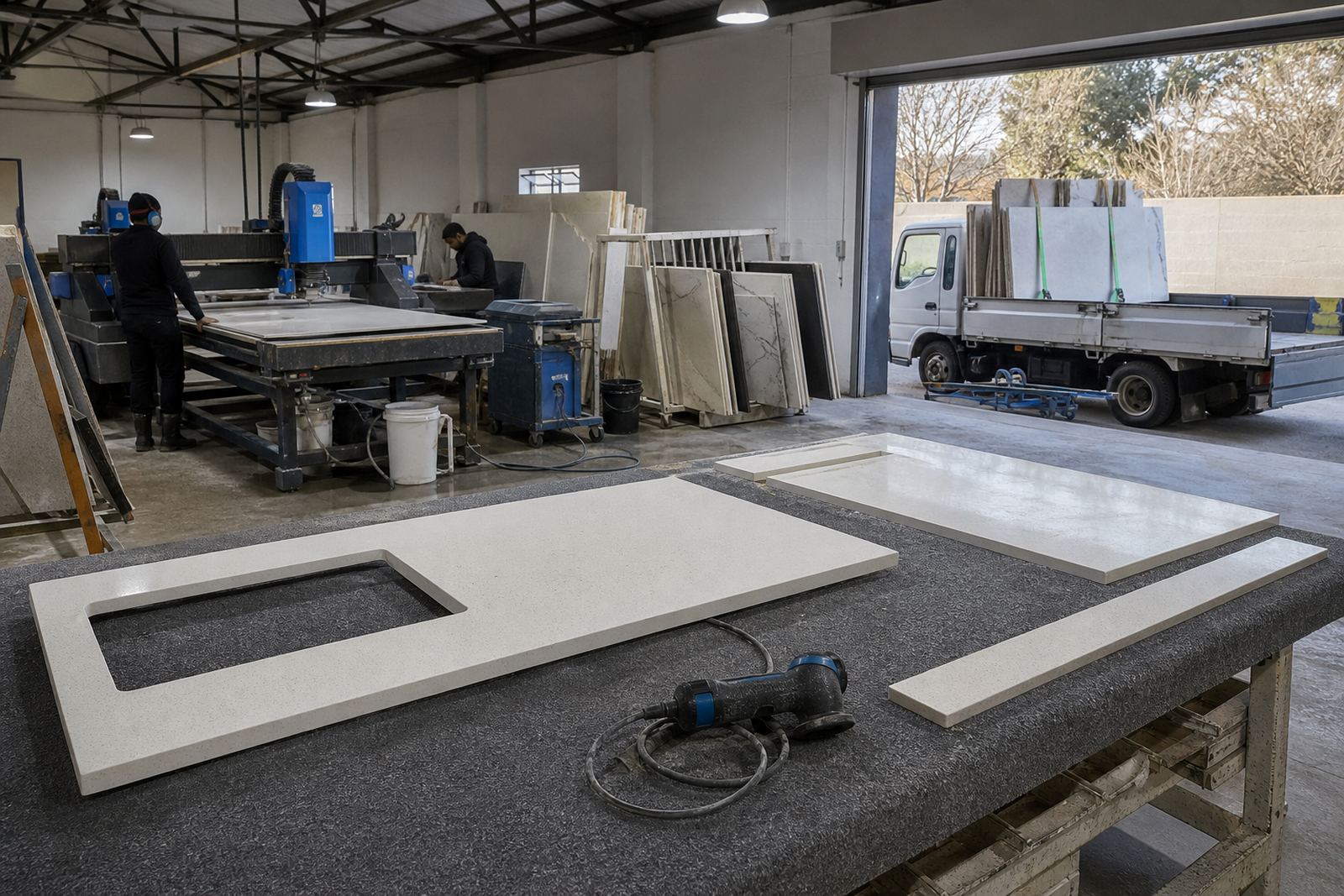
A workshop built around measured work
Plastone’s early work was shaped by the practical demands of kitchen and bathroom projects in Gauteng. The team learned quickly that engineered quartz and solid-surface tops only look right when the measuring, cutting and fitting are handled as one process, not as separate jobs passed around the room.
That approach still guides our work at the core of the business. A site visit leads into digital measuring and templating, then slab layout planning, cutting, edge profiling and the set-out of each sink cut-out or hob cut-out. It sounds straightforward on paper, but the detail lives in the corners, the joins and the final fit against walls that are never perfectly square.
- Site templating for new kitchens, bathrooms and fitted spaces
- Digital measuring for accurate fabrication notes
- Careful slab layout to reduce waste and keep the grain or pattern balanced
- Sink and hob cut-outs shaped for the planned appliance positions
How the material knowledge grew
As the workshop took on more varied interiors, the team built deeper working knowledge of how engineered quartz and solid-surface materials behave on site. Quartz is favoured for its dense, low-porosity face and the crisp line it gives to modern kitchens. Solid-surface is often used where a more integrated look is needed, especially around vanities, curved details and splashbacks that need neat returns.
That experience matters when edge profiles are being chosen, seams are being placed, or a top needs to carry a basin neatly without drawing attention to the join. Typical slab thicknesses are selected to suit the job, while support, overhangs and cut-outs are checked against the base units and the room itself. The result is not just a good-looking surface, it is one that behaves properly in daily use.
- Edge profiles can be kept square and clean or softened for a calmer finish
- Seams are planned to sit where they make sense visually and structurally
- Heat and stain care is discussed during handover, especially for busy kitchens
- Solid-surface joins can be blended to keep the finish visually continuous
Homes, offices and the people who call on us
The customer base has widened in step with the work itself. Homeowners come to Plastone for kitchen countertops, bathroom vanities and splashbacks that have to fit tight spaces and ordinary family routines. Offices need counters and vanities that are neat, durable and easy to maintain. Shopfitters often need a dependable workshop partner who can interpret drawings, site conditions and installation pressure without turning every detail into a problem.
Across Johannesburg, Sandton, Pretoria, Midrand, Fourways, Centurion and Roodepoort, the brief is usually the same at heart: make the surface fit properly and keep the finish calm. The project may be a compact vanity, a long island with a breakfast overhang, or a reception counter that needs a clean front edge and a tidy hob or sink opening. The team treats each one as a practical piece of joinery work, not a showroom exercise.
- Residential kitchens, sculleries and bathroom vanities
- Office counters and shared-use work surfaces
- Shopfitter projects that need measured fabrication and site co-ordination
- Splashback fitting where walls, tiles and cabinets have to meet cleanly
The team behind the benches
Plastone’s day-to-day work sits with a small group of specialists who each keep a different part of the process moving. Morne Moonsamy leads the business, while Lebo Mokoena keeps operations steady and Ayesha Naicker manages estimating so the job details match the material plan. Johan Ngwenya leads templating, and Sibusiso Mdlalose supervises the workshop where the slabs are cut and finished.
Candice Mthethwa plans installations so the sequence on site makes sense, and Thabo Rademeyer handles aftercare advice once the work is in place. That mix matters because countertop work can look simple from the outside, yet it depends on good communication between measuring, fabrication and installation. If one section is off, the full countertop will show it.
On a normal job the team is looking at corners, levels, overhangs, mitres, seam lines and the position of every cut-out. It is hands-on work, and the result depends on people who know how to read a room, not just a drawing.
What the workshop protects on every job
Long service has not changed the basic habits of the workshop. The team still works from site measurements, still checks cabinet lines carefully, and still plans each seam and edge with the installed room in mind. A shiny surface is not enough if the join lands in the wrong place, or if the splashback meets a wall that needs extra attention.
That same habit shows up in maintenance guidance too. Quartz and solid-surface both reward ordinary care, but the advice differs a little by material and by room use. Heat pads, chopping habits, staining risks from strong pigments, and regular wiping all form part of the aftercare conversation. On a busy family kitchen or a trade project, that practical guidance helps the finish stay presentable for longer.
- Use the right support around sinks and long spans
- Keep hot pans and sharp blades off the working surface
- Wipe spills before they sit on the top for too long
- Ask for maintenance notes that suit the material fitted in the room
Strijdom Park as the base for wider Gauteng work
Based in Strijdom Park, Randburg, Plastone works from a part of the city where access and scheduling matter. The workshop base allows the team to handle fabrication locally and then move into installations across Gauteng with the right pieces already prepared. That helps when a kitchen fit-out, vanity replacement or splashback job needs careful timing around other trades.
The branch and installation areas in Randburg, Johannesburg, Sandton, Midrand, Fourways, Pretoria, Centurion and Roodepoort reflect how the work has spread from the original workshop focus. The shape of the business has changed as the jobs have changed, but the core remains a measured one: accurate templating, careful fabrication and a finish that looks right in the room it was made for.
For clients, that means one team can handle the surface from first measure through to fitting and aftercare advice. For the workshop, it means the old habits still matter, and the details still decide how the job sits once the tools are packed away.