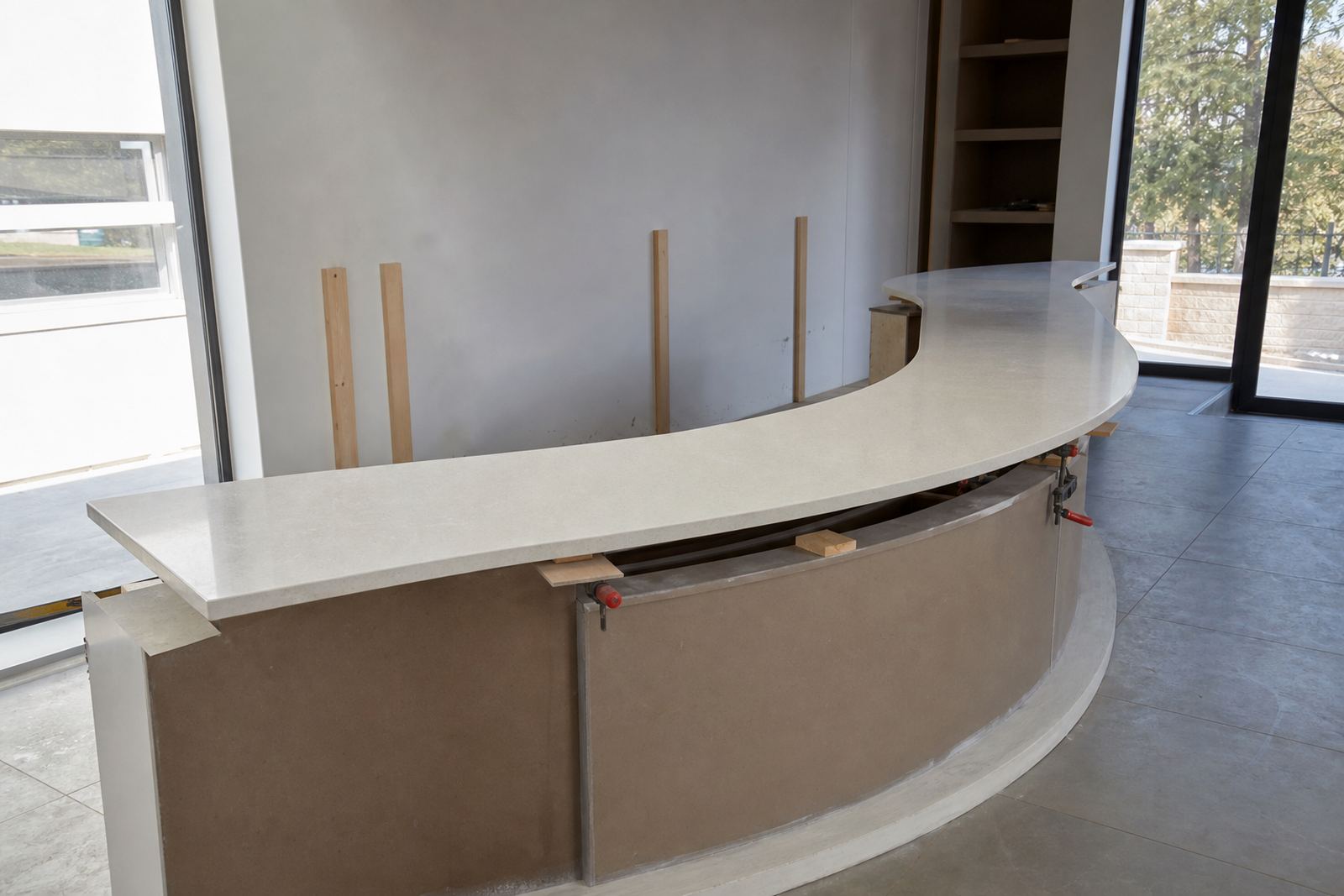
Reception counters that carry the front of the room
A reception top is usually the first hard-working surface visitors notice, so the form and finish matter as much as the wear resistance. In engineered quartz, the face is dense and evenly coloured, while solid-surface gives a warmer, more smooth look where joins can be kept discreet and shaped details are easier to carry through the full run.
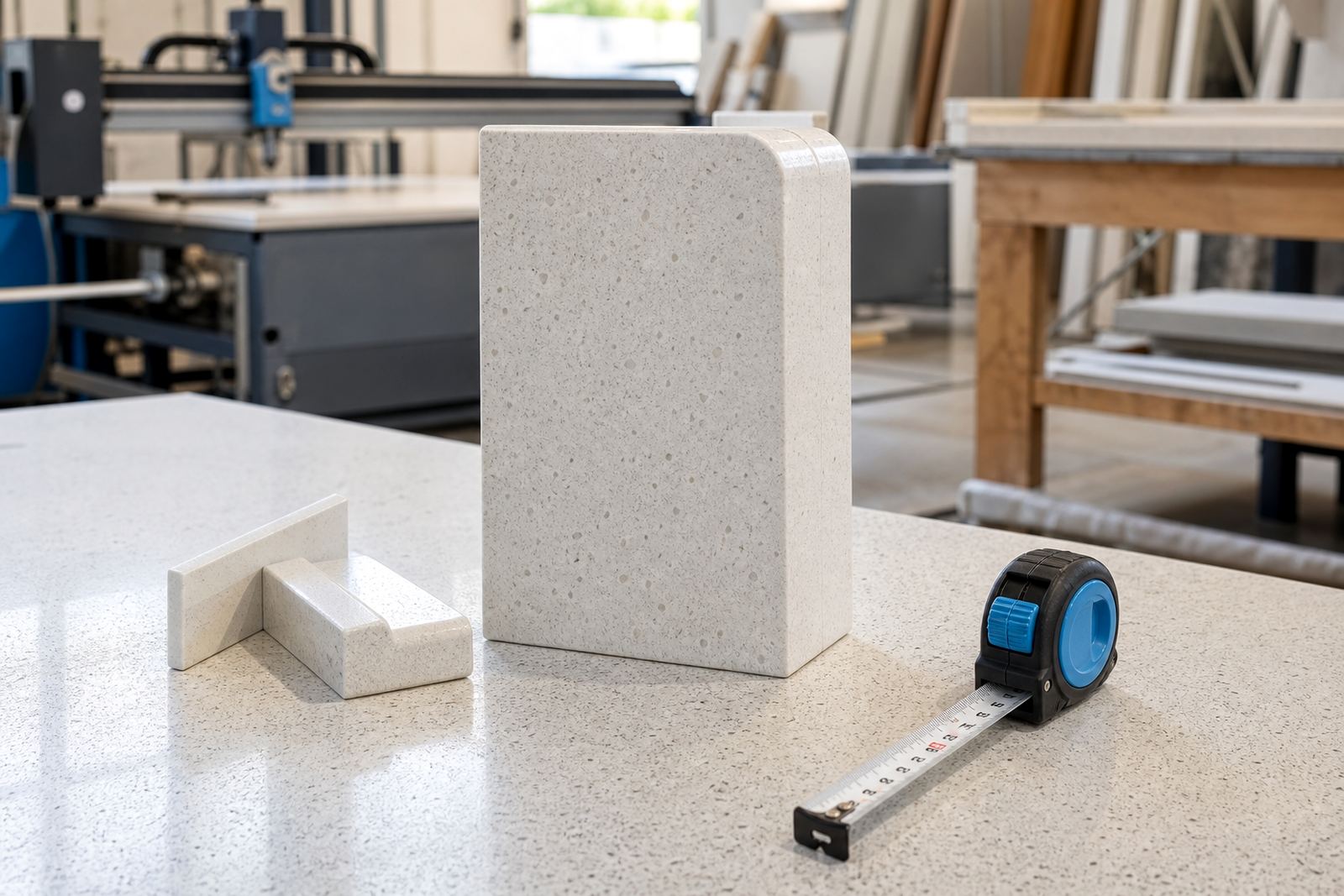
These counters are made to suit straight runs, L-shaped counters, wrap-around returns and raised front fascias. Typical top thicknesses are 20 mm and 30 mm, with thicker-looking edge builds available where the counter needs more presence from the public side. Edge profiles can be square, pencil-round, bevelled or softly radiused, depending on the feel you want at the customer side and the way the work surface will be used behind the counter.
Sizing, shapes and built-in details
Reception tops are measured from site, then drawn to suit the actual wall line, floor level and front fascia height. That matters in older buildings and busy office parks where walls are seldom perfectly square. We look at overhangs, support points, access panels, cable entries and the way the counter meets a screen, monitor stand or transaction opening.
- Top thickness: commonly 20 mm or 30 mm
- Edge options: square, pencil-round, bevelled, full bullnose or custom built-up fronts
- Returns: straight, L-shaped, U-shaped and stepped layouts
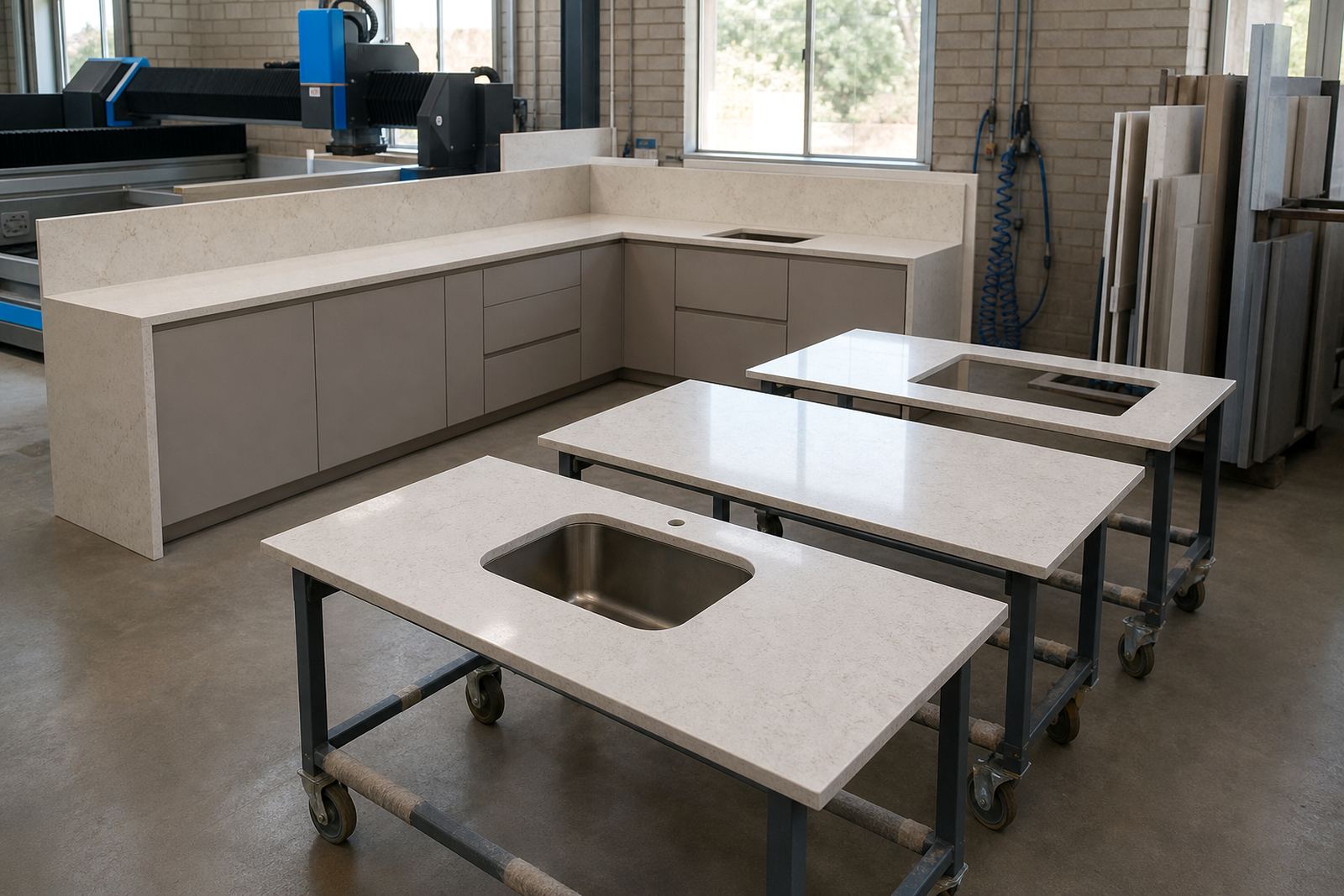
- Cut-outs: sink cut-outs, hob cut-outs where needed for hospitality counters, cable ports and service openings
- Join detail: matched seams placed where the layout allows the least visual interruption
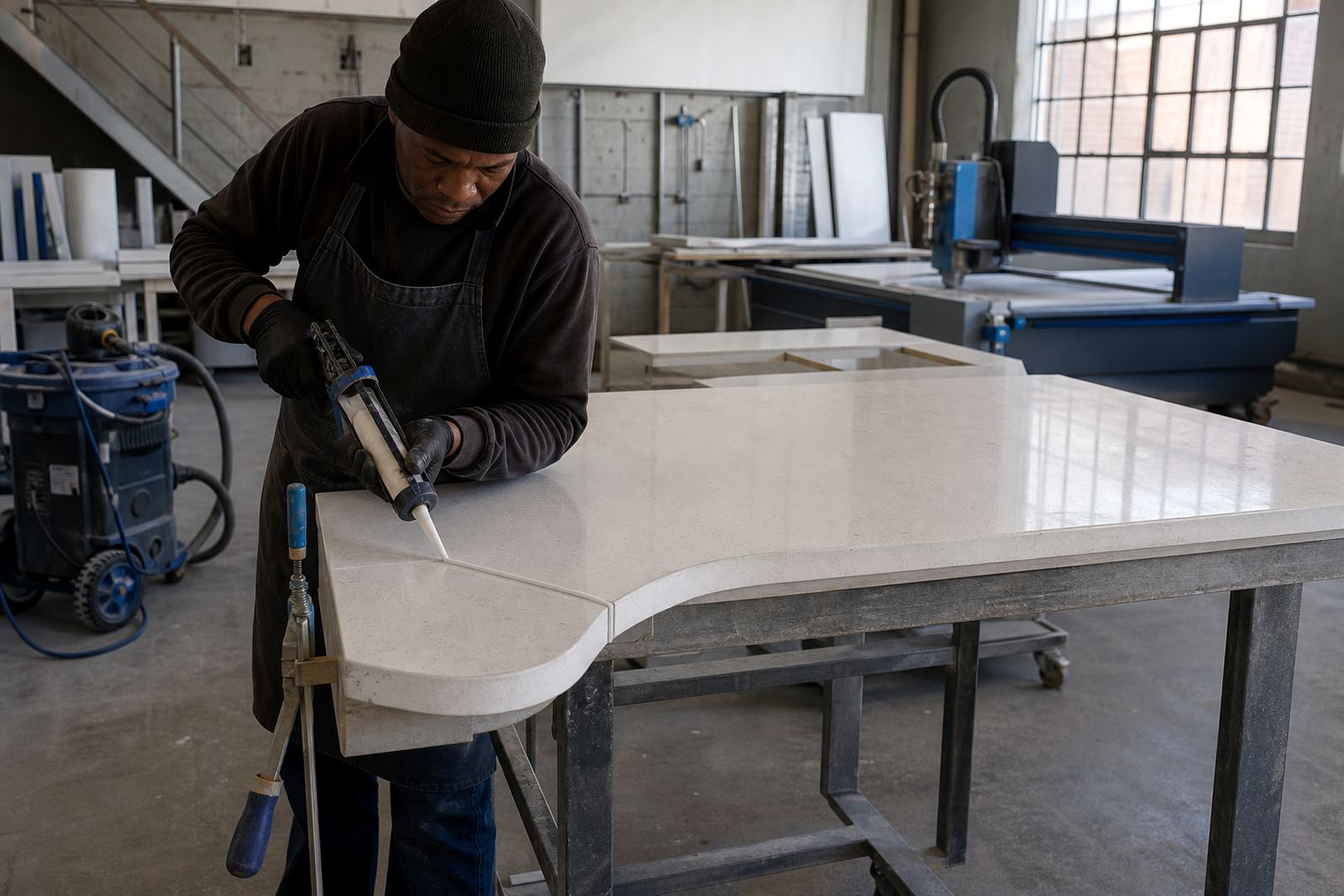
For larger reception pieces, slab layout planning is important. It helps position the grain or fleck pattern, reduce waste and decide where seams sit so the face of the counter reads cleanly from the entrance.
Where reception tops suit the day-to-day work
Reception counters suit office foyers, medical rooms, salons, estates, body corporate offices, school administration areas and retail welcome points. In Sandton and the northern suburbs, many counters need to carry a neat corporate look with modest maintenance. In quieter office settings, a plain straight run may be enough, while a larger front counter in Johannesburg or Pretoria might need layered fronts, privacy returns and a transaction shelf.
Solid-surface works well where the design calls for softer corners, integrated bends or a more matte finish. Engineered quartz suits reception tops that need a harder wearing stone look with consistent colour. Both materials handle normal office use well, including bags, keys, stationery and regular cleaning, though dark gloss finishes will show fingerprints more readily than a satin surface.
- Corporate foyers and client-facing entrances
- Medical reception and waiting areas
- Retail service counters and till points
- School, church and civic administration counters
- Salon, spa and studio welcome counters
Templating, fitting and site work
Reception tops depend on accurate templating because a few millimetres out can throw off the entire front line. Our team measures the opening, the return walls, the floor falls and any service penetrations before fabrication. Where the counter wraps around a column, display niche or wheelchair-access section, the template captures the exact shape so the cut piece sits properly on installation.
Installation normally needs access to the site after the base structure, carcass or counter frame has been secured. The top is then offered up, adjusted, joined and sealed. Where seams are unavoidable, they are planned to fall in less obvious positions and pulled tight so the colour match and surface line stay neat. On full-height front fascias, returns and peninsulas, proper support is essential to stop flex over time.
For counters with sinks, under-mount basins or service openings, the cut-out must be reinforced and finished carefully around the edges. That is especially important in solid-surface work, where the jointing and sanding sequence affects the final appearance. Power points, data ports and pass-through slots are also coordinated during templating if the reception layout calls for them.
Everyday care for quartz and solid-surface
Reception tops keep their finish better when spills are wiped before they dry. Tea, coffee, cosmetic products and hand sanitiser should not be left sitting on the surface for long periods. Wash with a soft cloth, mild soap and water, then dry the top so water spots do not build up around taps or joints. Harsh scourers, abrasive powders and solvent cleaners can dull the surface and should be avoided.
Quartz tolerates heat better than many laminated surfaces, but hot mugs, kettles and equipment bases still need protection. Solid-surface is easy to refresh if minor marks develop, though it also benefits from hot items being kept off the direct surface. A simple coaster or serving mat saves a lot of wear near busy reception points where people set things down without thinking.
- Wipe spills promptly, especially coloured drinks and cosmetics
- Use chopping boards, coasters and heat pads where needed
- Avoid sharp impact on corners, edges and sink rims
- Check seals around cut-outs during routine cleaning
- Keep acidic or solvent-based cleaners away from the finish
What to confirm before ordering a reception top
A clear brief lets our fabrication run more smoothly. We need the overall length, depth and height, plus whether the counter is straight, angled, curved or made with a front return. It also helps to know if the top must match existing cabinetry, if the public side needs a built-up face, and whether the working side needs splash protection or a raised shelf.
Colour choice matters too. Light quartz can brighten a small foyer, while darker tones suit formal offices and high-contrast interiors. Solid-surface gives more scope for shaped returns and integrated looks, while quartz usually suits sharper lines and a mineral finish. We also check access to the building, the lift size if relevant, and whether any old counter or cladding must be removed first.
Clients in Randburg, Fourways, Midrand, Sandton, Roodepoort, Johannesburg, Centurion and Pretoria may send the main dimensions through our contact form on our contact page. For a proper fabrication brief, include photos of the site, the counter opening, the front face and any cut-outs that must be accommodated.
Local fabrication from Strijdom Park, Randburg
Plastone fabricates reception tops from our Strijdom Park, Randburg workshop for offices, shopfitters and property owners who need a presentable finish with proper structure behind it. The work can include site templating, digital measuring, slab layout planning, cutting and fabrication, edge profiling, seam joining, splashback fitting and aftercare advice where the counter forms part of a larger fit-out.
That combination matters on reception jobs, because the front of the room has to look right from the first day and stay sensible to maintain in a real working space. Whether the brief is a compact welcome ledge or a long reception run with returns and visitor-facing panels, the final piece needs accurate dimensions, stable support and a clean edge detail. Morne Moonsamy leads the team, with operations, templating, fabrication and installation coordinated across Gauteng.
Key facts
| Material options | Engineered quartz or solid-surface |
|---|---|
| Typical thickness | 20 mm or 30 mm, with built-up edge options |
| Edge profiles | Square, pencil-round, bevelled, bullnose or custom |
| Common formats | Straight runs, L-shapes, U-shapes and curved returns |
| Site services | Templating, digital measuring, fabrication and installation |
| Coverage area | Randburg, Johannesburg, Sandton, Midrand, Fourways, Pretoria, Centurion and Roodepoort |