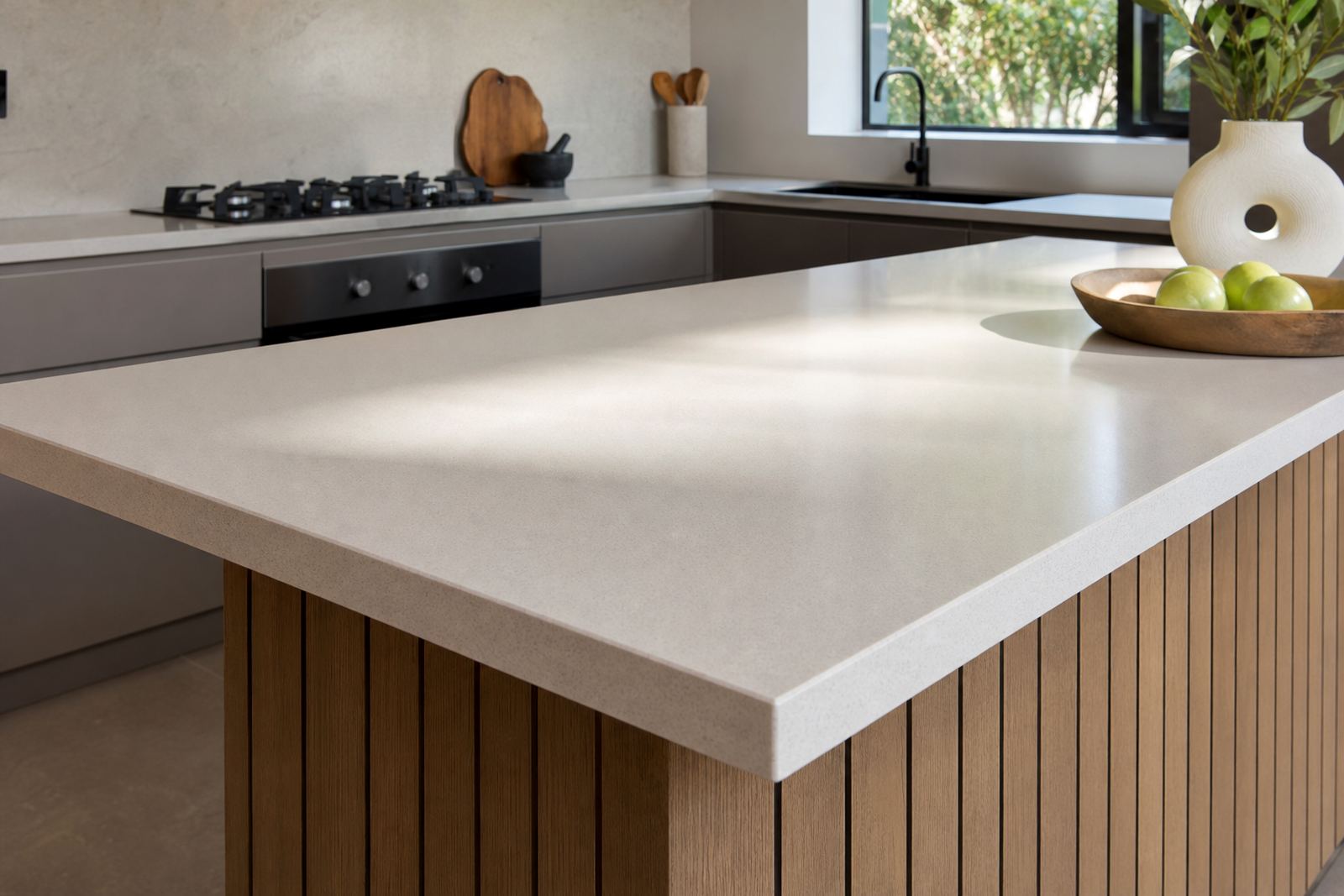
A softer finish with real working tolerance
Every satin solid surface job starts with site templating. That stage captures wall movement, out-of-square corners and any sink or hob positions that need exact cut-outs. In a kitchen or vanity run, a few millimetres matter, so the template has to reflect the real room not the drawing on paper.
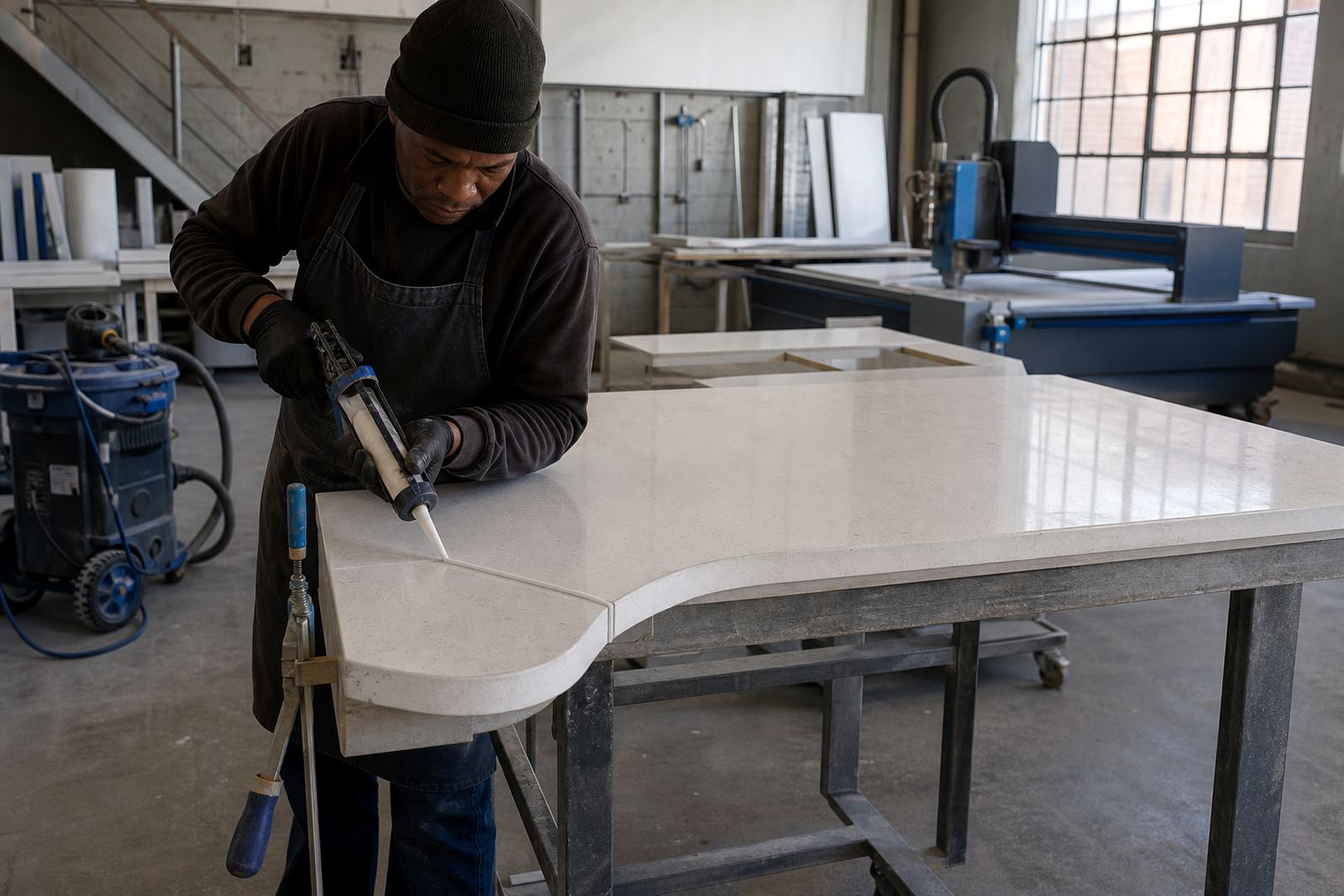
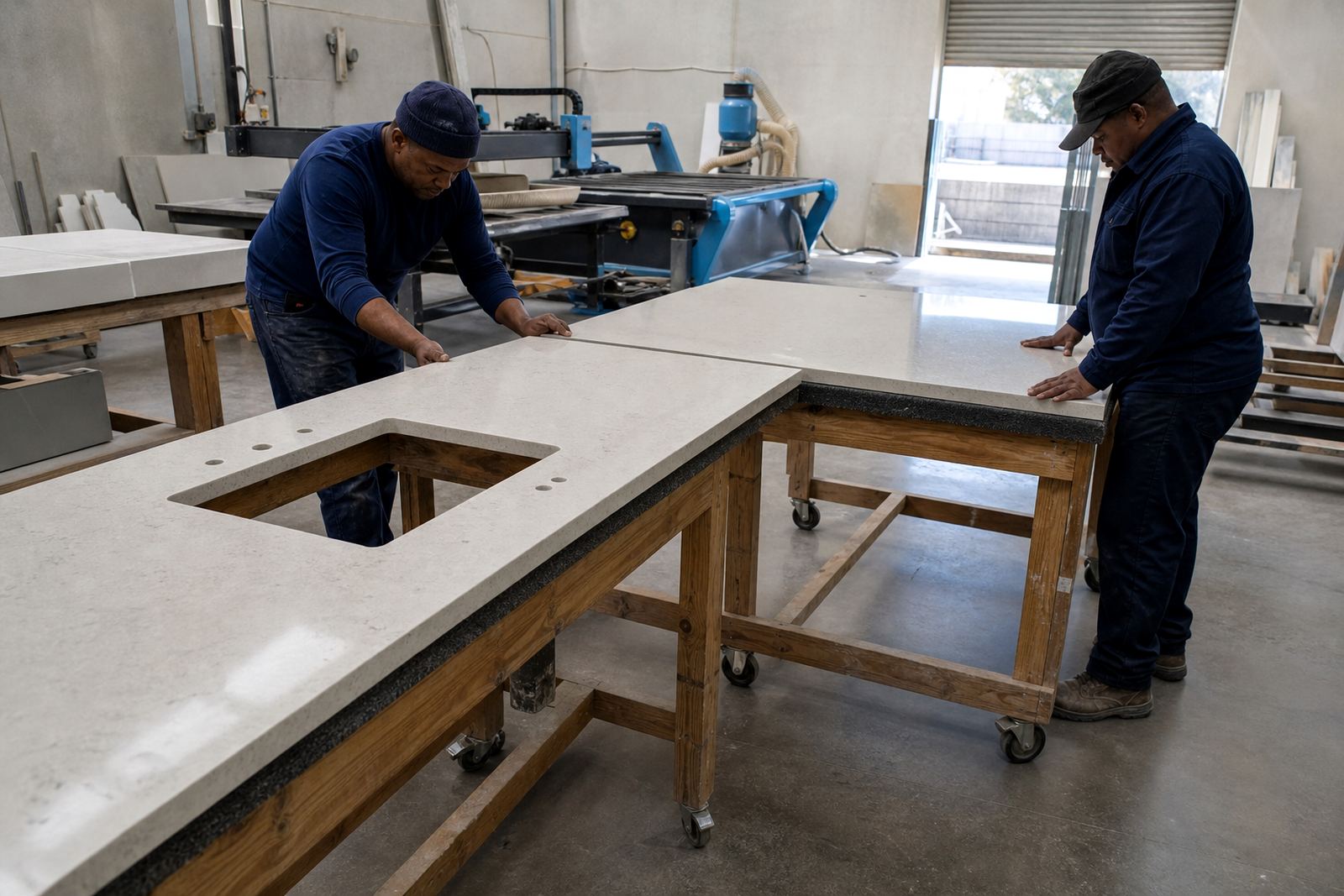
We fabricate for straight runs, L-shapes, U-shapes and islands, then plan joints so the line sits where it is least visible and strongest. Seams can be bonded and sanded flush, which helps on long counters, but the access route and room layout still affect the final joint positions.
- Digital measuring for accurate wall-to-wall dimensions
- Sink cut-outs sized to the bowl and fixing method
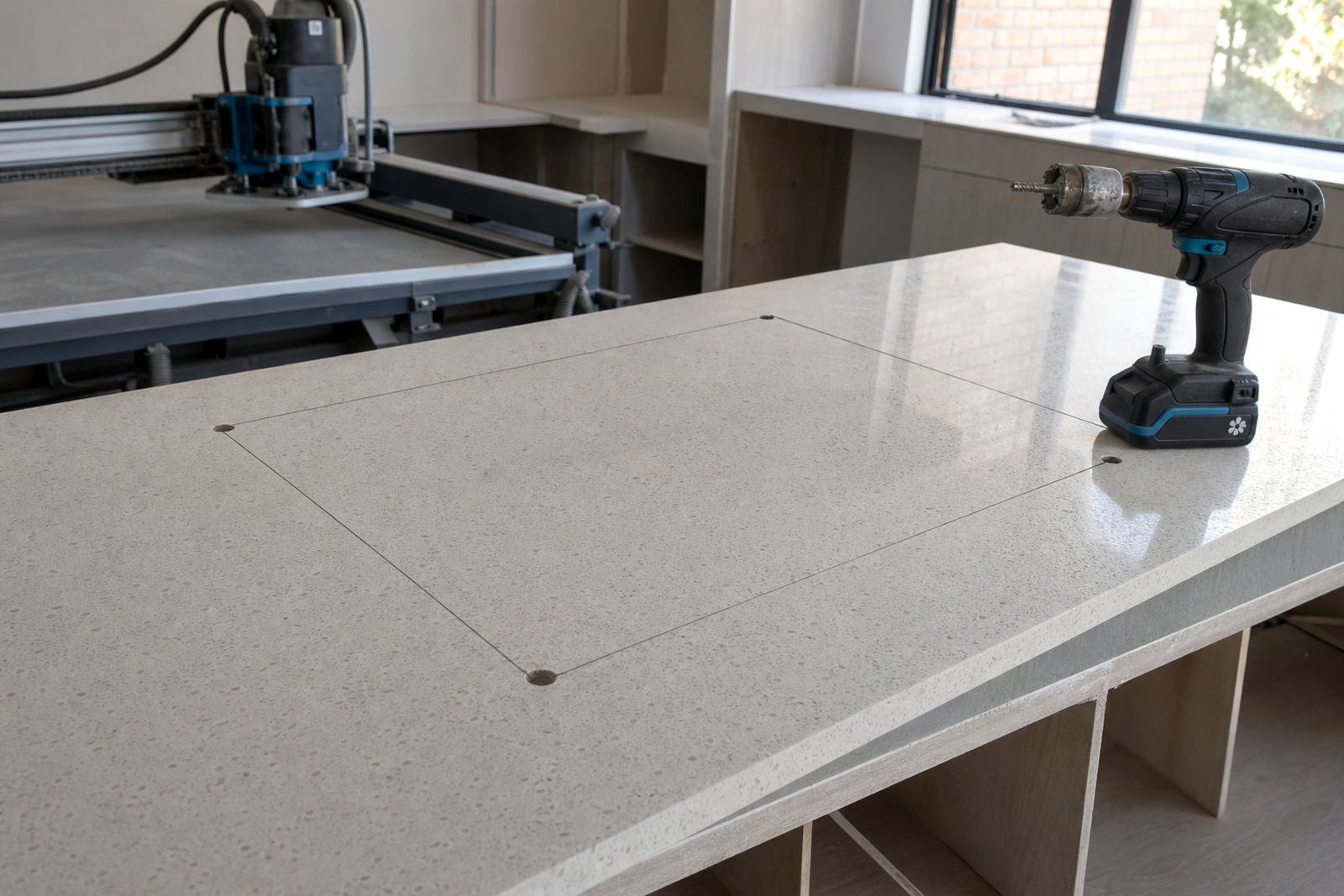
- Hob cut-outs planned around heat clearances and support
- Drip grooves, upstands and splashback returns where needed
Where satin solid surface sits well
This finish works well in homes, medical consulting rooms, boardrooms, reception counters and shopfit displays. The softer sheen is kinder under bright ceiling light, so fingerprints and cleaning swirls do not stand out as much as on a gloss top. In a bathroom it can pair neatly with an integrated basin or a routed undermount bowl, while in a commercial counter it gives a neat face for everyday handling.
For splashback use, the same material can be carried up the wall behind a counter or basin to reduce visible joints. In a shopfit setting, the material is often used for service counters and product display plinths where the edge needs to stay clean and the top must be easy to wipe down between customers.
- Kitchen worktops and islands
- Bathroom vanities and laundry counters
- Reception counters and cashier counters
- Wall-up splashbacks and feature panels
Edges, joins and cut work that shape the final result
Edge profiles change the whole look. A pencil edge feels light and neat, a square edge reads more modern, and a built-up edge gives the impression of a thicker slab. On satin solid surface, edges are usually eased rather than left sharp, because the material is often handled close-up in homes and customer-facing spaces.
Sink cut-outs, tap holes and hob openings need clean machining, then careful sealing and support underneath. If a run spans several metres, the seam position, substrate and bracket spacing all matter. The top may sit on cabinets, a frame or a prepared base, and the supporting structure has to be level before installation starts.
- Edge profiles can be square, eased, pencil or built-up
- Seam lines are planned to balance strength and appearance
- Undermount sinks need accurate support and fixing points
- Cut-outs for taps, dispensers and accessory fittings are measured from site conditions
Care that keeps the satin face looking even
A satin finish asks for steady, ordinary care. Warm soapy water and a soft cloth cover most day-to-day cleaning, while a non-abrasive cream cleaner helps with marks that sit on the surface. The aim is to clean the top without polishing patches into the finish, because that can make parts of the slab look uneven under light.
Hot pots, trays and pans should not be dropped straight onto the top, and coloured spills like wine, tea, turmeric or fruit juice are best wiped soon after they land. Solid surface has good stain resistance, but a wet patch left for long enough can still leave a mark on lighter colours. A heat mat, chopping board and gentle cleaning routine go a long way on a busy counter.
- Use soft cloths, not scourers or steel wool
- Wipe spills before they dry into the grain or seam line
- Place hot cookware on a trivet or heat pad
- Light surface marks can often be sanded and refinished
What to confirm before fabrication starts
Good paperwork saves site trouble. We need the exact room use, the slab colour, the preferred finish and whether the counter needs an integrated splashback, an undermount basin or a hob opening. A bathroom vanity needs different cut-out positions to a kitchen island, and a shop counter may need a deeper overhang for customer seating or equipment clearance.
It also helps to confirm the cabinet size, wall finish, appliance models and the access route into the building. If the installation is in Sandton, Pretoria, Midrand or Fourways, stairs, lifts and parking access can affect how large sections are moved. For larger commercial jobs, slab layout planning matters because the grain direction, joint positions and visible faces all need to line up with the room.
- Overall dimensions and any confirmed site template
- Colour, finish and slab thickness
- Sink, hob and tap positions
- Edge profile, overhang and splashback height
- Delivery access, floor level and installation date window
Made in Strijdom Park for Gauteng fitting teams
Plastone fabricates satin solid surface products in Strijdom Park, Randburg and fits across Johannesburg, Sandton, Pretoria, Midrand, Fourways, Centurion and Roodepoort. Our workshop handles cutting and fabrication, edge profiling, seam joining, splashback fitting and countertop installation, with aftercare advice once the top is in place.
The work suits homes, offices and shopfitters that need a measured finish and a tidy install. Morne Moonsamy leads the business with a team that includes Lebo Mokoena on operations, Ayesha Naicker on estimating, Johan Ngwenya on templating, Sibusiso Mdlalose in the workshop, Candice Mthethwa on installations planning and Thabo Rademeyer on aftercare. Enquiries come through our contact form, and the details are best sent with room measurements, photos and the type of counter you need.
- Site templating and digital measuring from Gauteng sites
- Cutting, fabrication and seam joining in our Randburg workshop
- Installation for kitchens, vanities, counters and splashbacks
- Aftercare advice for day-to-day cleaning and surface care
Key facts
| Material | Engineered solid surface sheet with satin finish |
|---|---|
| Common thickness | 12 mm, 20 mm and 30 mm, depending on the design |
| Finish options | Satin, matt and light sheen refinishing |
| Typical uses | Kitchens, vanities, splashbacks, reception counters |
| Fabrication methods | Templating, CNC cutting, edge profiling, seam bonding, sanding |
| Care level | Warm soapy water, non-abrasive cleaner, heat mat for hot items |