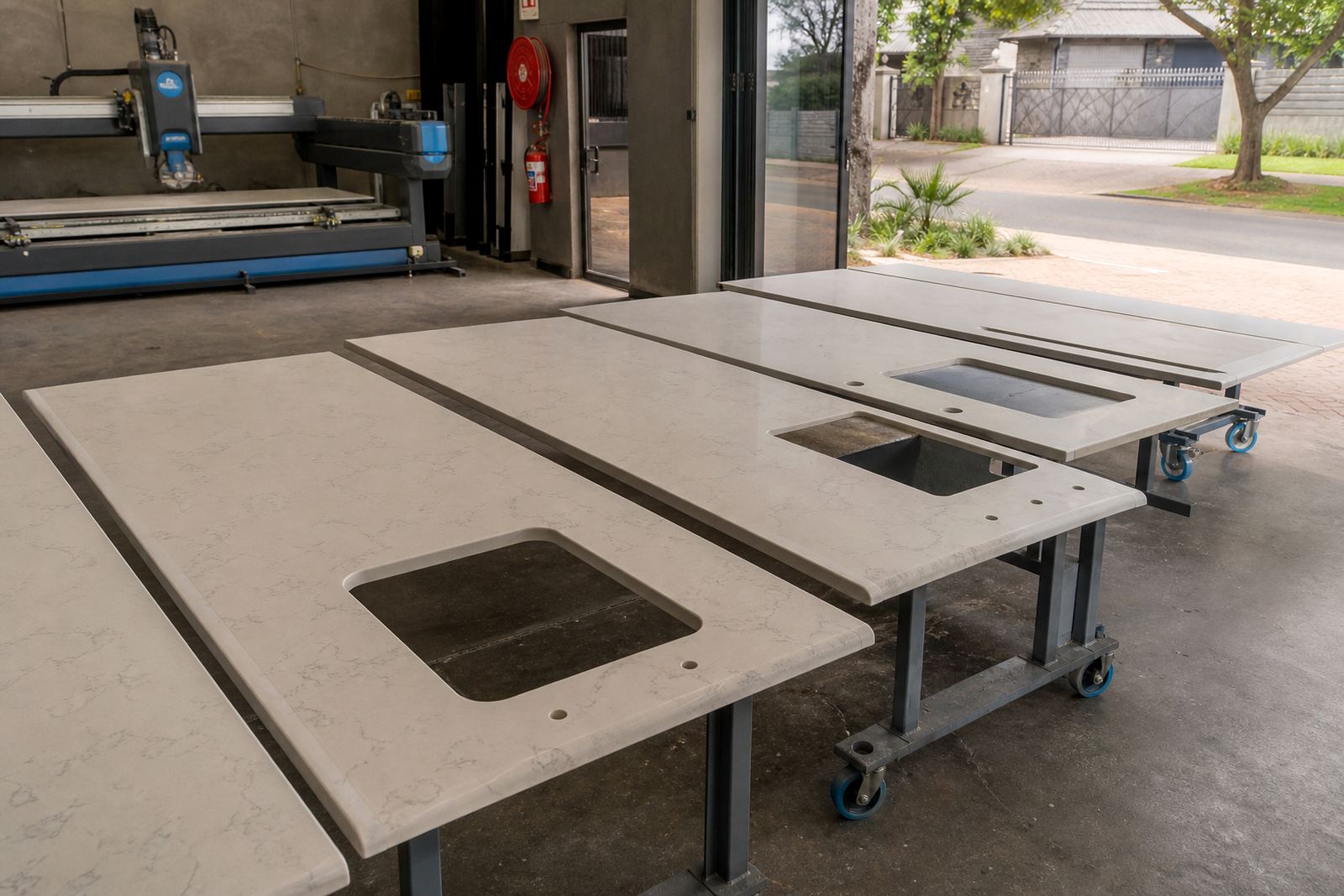
Counters built around the till point
Retail counters carry more than a sales point, they hold a till, card machine, cables, paperwork and the wear that comes with daily trade. We fabricate shop counters in engineered quartz and solid-surface to suit front-of-house use, back counters, wrap stations and payment ledges, with profiles that stay neat under constant handling.
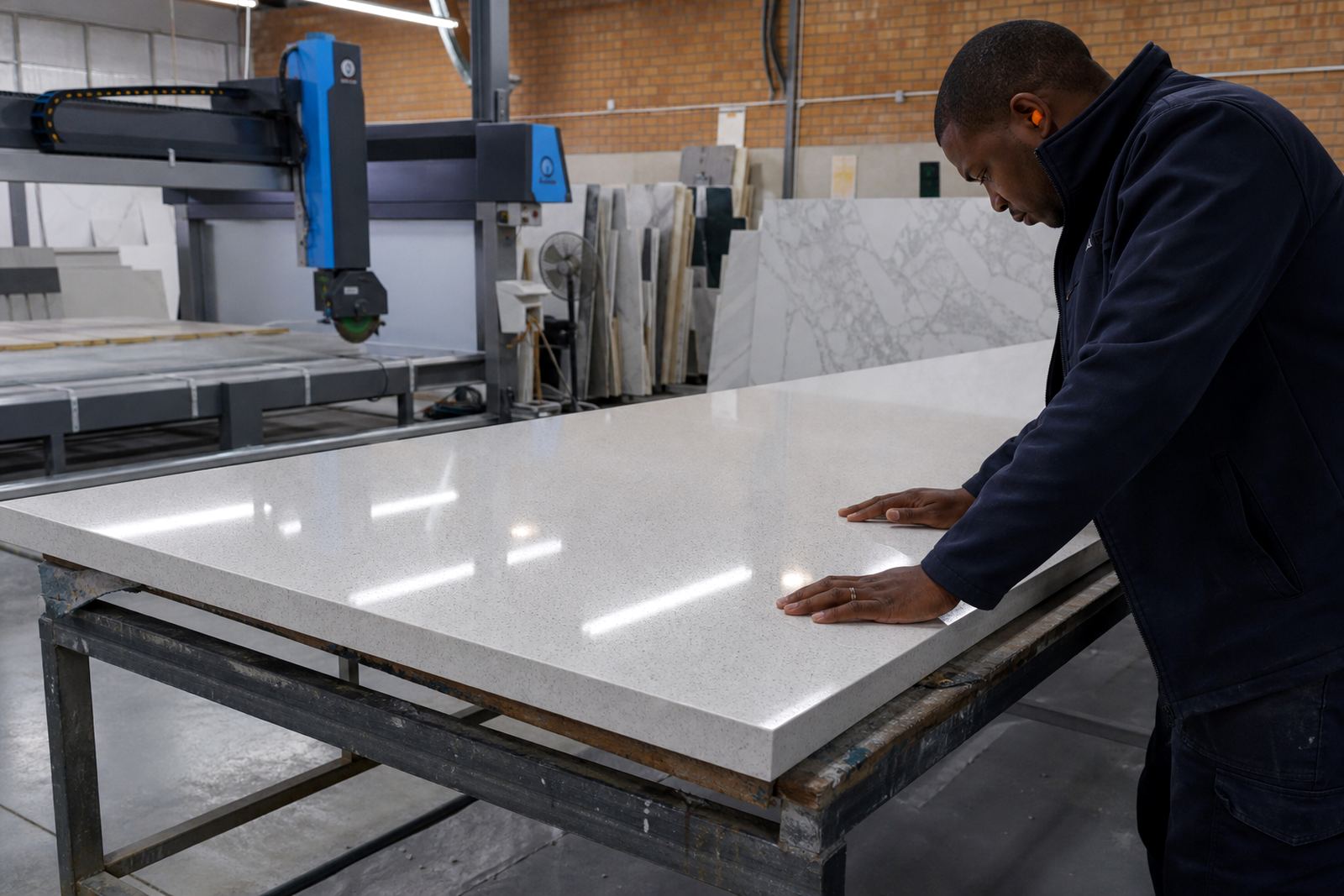
Typical tops are made from 12 mm or 20 mm slab material, depending on the look and the support below. Quartz gives a dense, stone-like finish for busy retail settings, while solid-surface allows tighter shaping on curved fronts, integrated returns and more visible seam control on longer runs.
- Surface lengths are planned around the actual counter line.
- Edge profiles can be straight square, bevelled, pencil-round or a thicker built-up look.
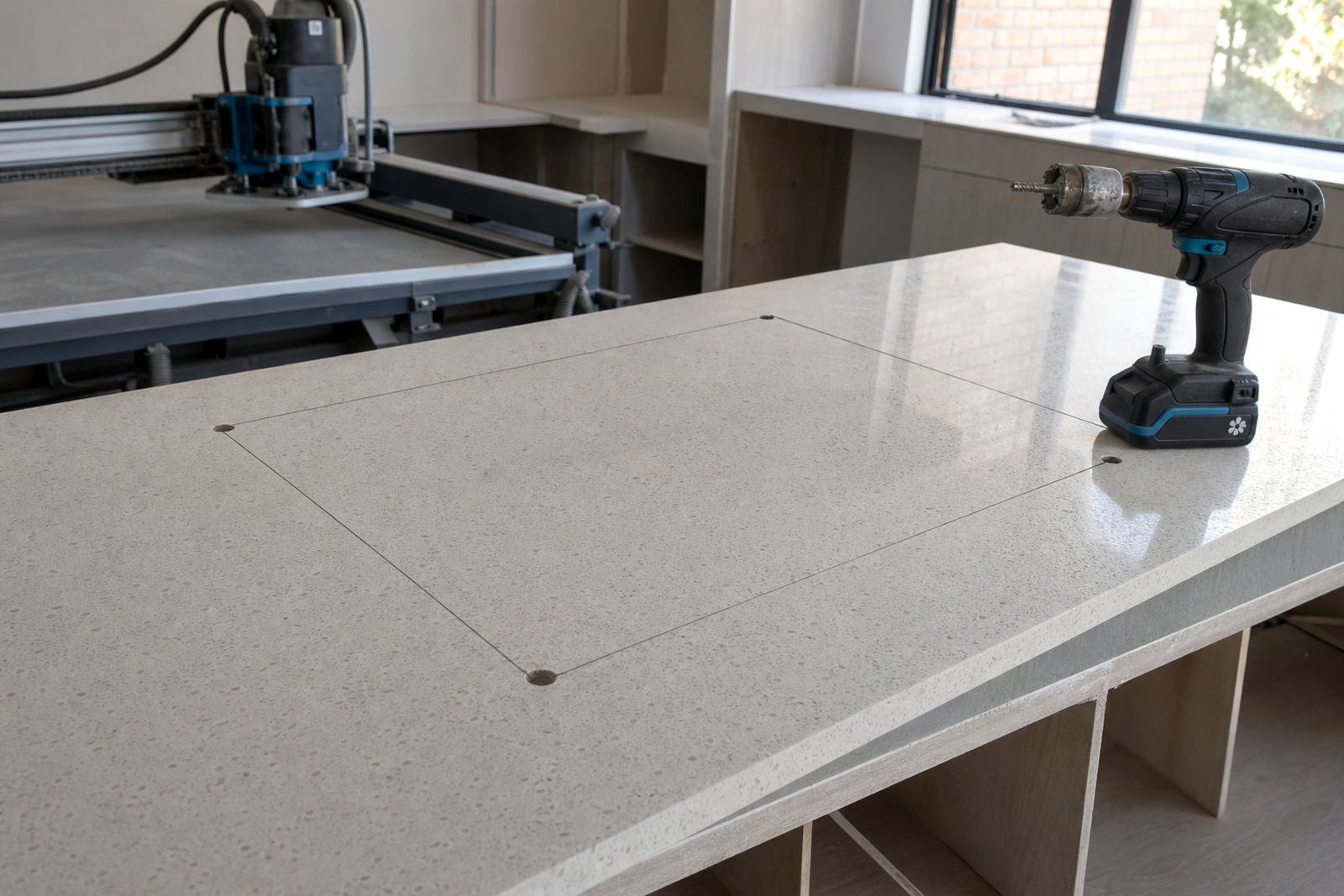
- Cut-outs can be made for monitors, receipt printers, cable grommets and cash drawer lines.
- Where a service ledge is needed, the top can be stepped or returned for better working height.
Sizes, thicknesses and edge choices
Most shop counters work best when the top, fascia and support frame are planned together. A slimmer 12 mm top suits a lighter retail finish, while 20 mm gives a heavier visual line and more presence across a sales counter or cashier island. On long runs, support spacing matters, especially where the top carries a recessed till section or a deep overhang for customer signing.
Edge detail changes the character of the counter. A sharp square edge gives a precise modern line, while a softened pencil edge is kinder on hands and bags at the point of sale. Built-up edges can be used when the shop wants the top to look thicker than the slab itself, without adding unnecessary weight.
- Standard tops can be made for straight bays, L-shapes and wrapped service counters.
- Overhangs are measured against the frame so stools, knees and access paths are not blocked.
- Corner returns can be mitred for a cleaner finish at customer-facing bends.
- Where spill risk is high, raised edges or small lips can be added at the rear.
Cut-outs that keep the front end tidy
Shop counters often need exact openings for equipment and services. A till cut-out needs enough space for the housing, but also room for the cable run and any service access below. Cable points, charging ports and flush-mounted hardware should be marked before fabrication starts, because small shifts on site can change the whole line of the counter.
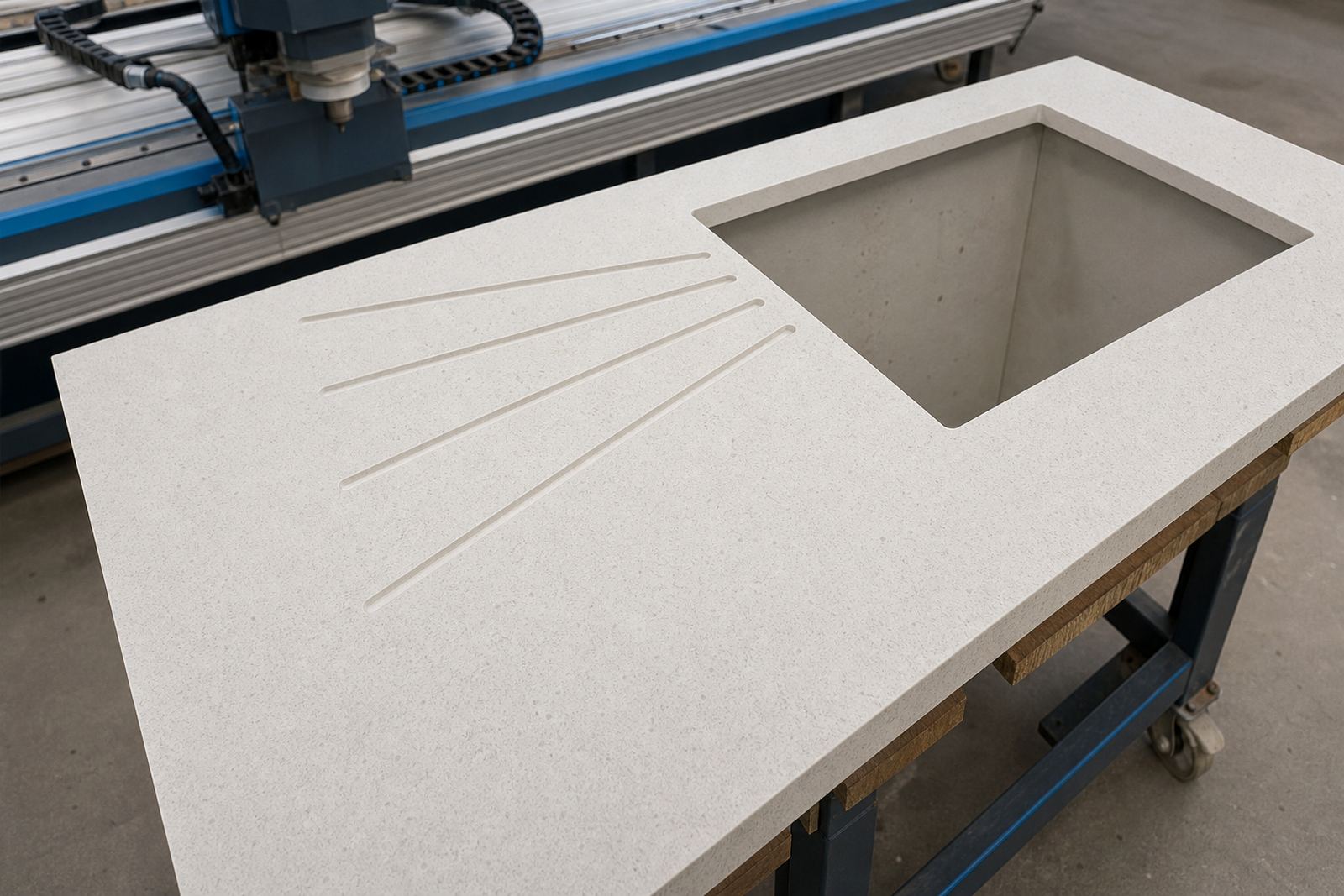
We also handle sink cut-outs where a retail counter doubles as a refreshment station or service point, though the same care applies to any opening near the front edge. Seams are placed away from the busiest touch points where possible, and where a long counter cannot be made from one piece, the joint is planned so it sits in a quieter section of the run.
- Templates are taken from the actual site walls, not from a rough sketch alone.
- Cut-outs can be shaped for under-counter fridges, sinks, taps or inset fittings.
- Seam placement is coordinated with cabinet divisions and support points.
- Internal corners are eased where hardware and cleaning access need extra clearance.
Where shop counters fit best
These counters suit boutiques, reception points, pharmacies, salons, showrooms, small supermarkets and service counters inside offices. They are also practical for shopfitters who need a measured countertop set that can travel into a live fit-out without last minute trimming on the floor. In busy retail areas around Johannesburg, Sandton, Midrand, Fourways, Pretoria and Randburg, a properly made counter helps the front end stay neat through long trading hours.
In coastal or humid areas, material choice and detailing matter even more around timber bases and cabling. Quartz keeps a crisp finish where the shop wants a polished face, while solid-surface is often used where the design calls for smooth curves, coved transitions or a continuous colour field through the top and fascia.
- Front counters for retail floors and customer check-in points.
- Back counters for wrapping, bagging and stock staging.
- Display counters that need a clean viewing edge and stable work top.
- Cashier stations where the counter has to carry daily pressure and constant handling.
Fitting, support and site conditions
A shop counter is only as strong as the structure beneath it. Before installation, the support frame, cabinet line and wall finish must be ready for templating or final fitment. If the counter has a return, a raised payment shelf or a stepped transaction area, those lines need to be set out early so the finished top lands properly on the cabinets and the customer side stays level where it should.
Our installations team handles the fitting across Gauteng, with templating, digital measuring, slab layout planning, cutting, edge profiling and seam joining all handled in sequence. On site, the installer checks level, access, corner movement and any service points that pass through the counter body. If a splashback or side return is part of the job, it is best planned with the top so the joins line up cleanly.
For shopfitters, the useful details are usually the ones that save rework: exact overall length, face height, overhang depth, return length, sink or till position and whether the front edge needs a softer hand-friendly profile. That is where the fabrication note becomes a proper fitout document, not just a rough size.
Care after the opening rush
Engineered quartz and solid-surface both need sensible care in a retail setting. Wipe spills with a soft cloth and mild cleaner, and avoid dragging sharp packaging, scissors or display hardware across the top. Heat from mugs, food warmers or service equipment should be managed with pads or stands, because direct heat can mark or stress the surface over time.
For stained areas, clean sooner rather than later. Coffee, cosmetics, adhesives and some cleaning fluids can leave a trace if they sit too long, especially on lighter colours. Solid-surface can often be revived more easily after surface marks, while quartz usually keeps a stable finish with routine cleaning and careful use around the sink and till zone.
- Use cutting boards or trays rather than working directly on the counter.
- Keep solvent-heavy products away from exposed edges and seams.
- Check silicone lines around sinks, returns and splashbacks during routine cleaning.
- Report chips, movement or seam issues before they spread into a bigger repair.
Details to confirm before fabrication starts
Good shop counters depend on clear measurements and a proper brief. The best order details include the counter shape, slab colour choice, thickness, edge profile, whether the front face is plain or wrapped, and exactly where the till, cable and sink openings must sit. If the counter is going into a live retail floor, the access route, lift size and fitting sequence should also be confirmed before the slab is cut.
Plastone handles shop counters from our Strijdom Park, Randburg base, with fabrication for Johannesburg, Sandton, Pretoria, Midrand, Fourways, Centurion and Roodepoort. Use our contact form to send the counter layout and till position, and our team keeps the process practical from site measure through to final fit. The project is usually smoother when the cabinet maker, electrician and fitter all work from the same drawing set.
- Overall length, depth and finished counter height.
- Material choice, slab thickness and preferred edge profile.
- Positions for till cut-outs, cable grommets, sinks and service openings.
- Any return panels, raised ledges, splashbacks or matching vanity fronts.
Key facts
| Material options | Engineered quartz or solid-surface |
|---|---|
| Common slab thicknesses | 12 mm and 20 mm |
| Edge profiles | Square, bevelled, pencil-round, built-up |
| Typical cut-outs | Till, cable grommet, sink, hob-style service opening |
| Installation area | Gauteng, including Johannesburg, Sandton, Pretoria, Midrand and Fourways |
| Related services | Site templating, digital measuring, cutting, seam joining, splashback fitting, countertop installation |