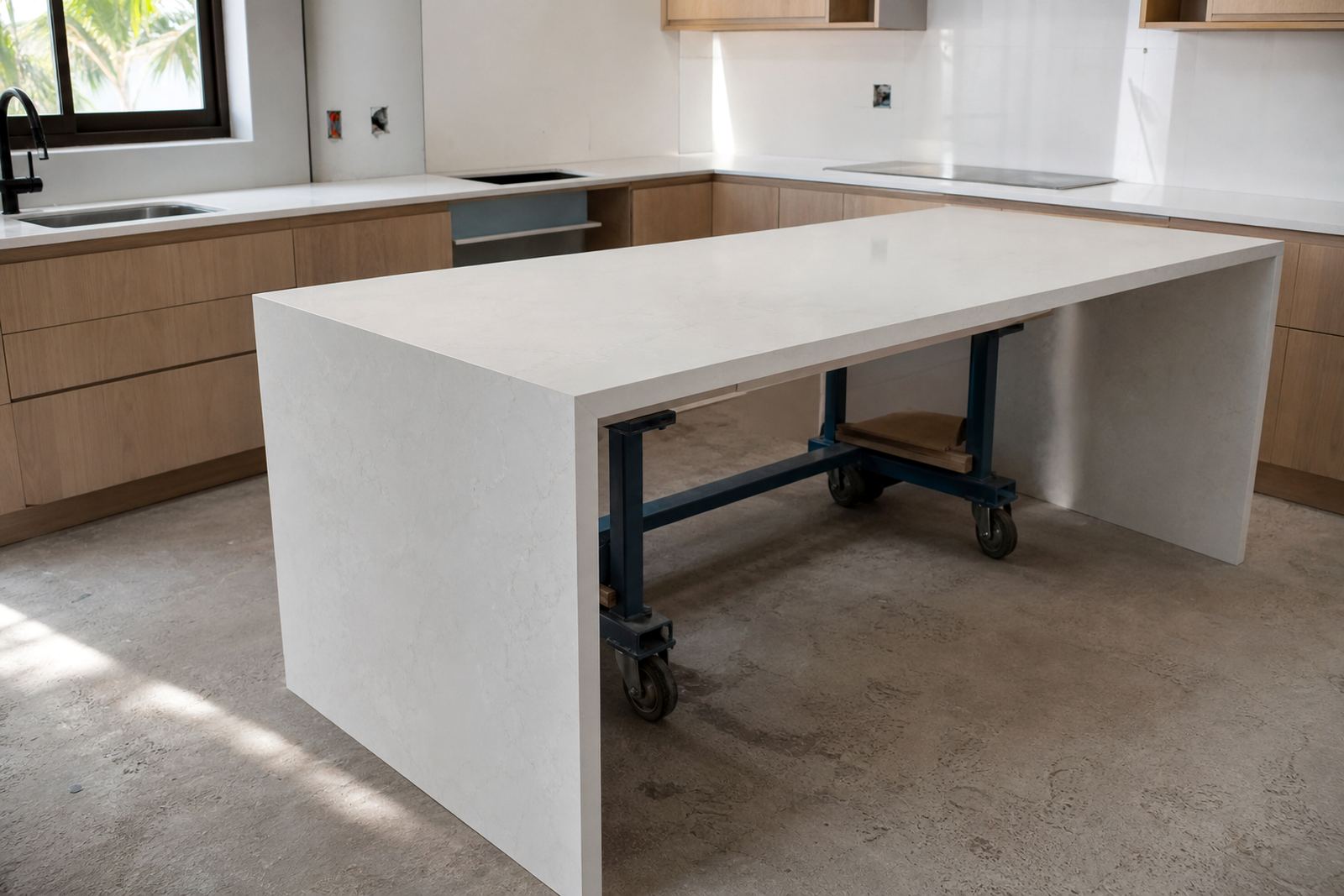
What a waterfall end changes on an island
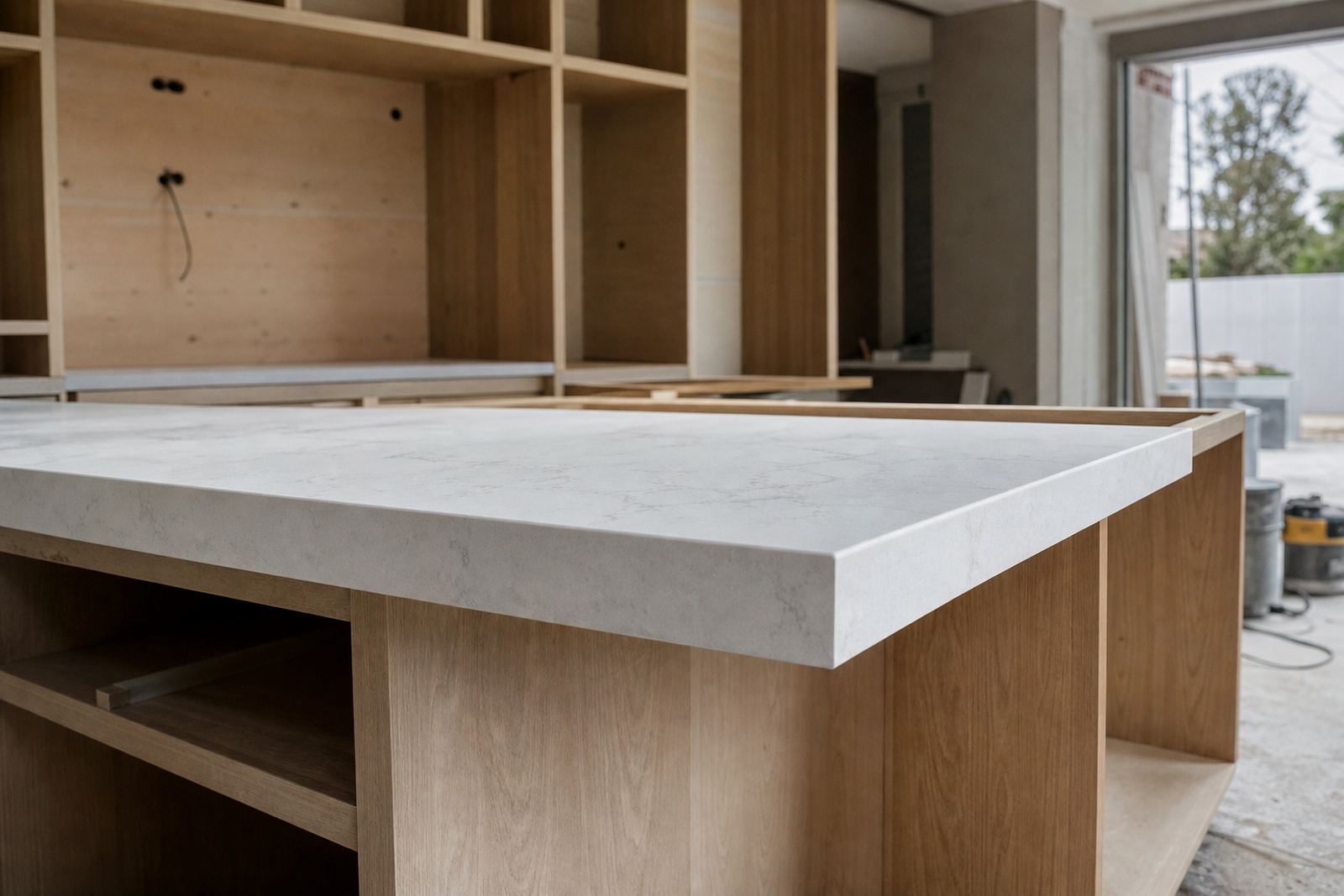
A waterfall end is a vertical return that drops from the top surface to the floor, usually on one or both exposed sides of an island. In quartz work the look depends on matching the slab grain or veining across the corner, while solid-surface jobs can be worked with tighter visual continuity because joints can be sanded and blended more easily. The finished panel is cut, edged and joined so the face lines up with the top, the overhang stays true and the corner reads as a single form.
This detail suits islands that are seen from several sides, especially where the client wants the cabinetry hidden and the material to carry the visual weight. It also protects the end of the base from knocks in busy kitchens, hotel suites and office tea areas. On a good layout, the waterfall end becomes part of the furniture rather than a separate add-on.
- Common slab thicknesses are 20 mm and 30 mm, with build-up used where a thicker look is wanted.
- Edge profiles can stay square, softly eased, pencil round or mitred for a heavier visual edge.
- The end panel is usually set out to match the top grain or pattern direction before cutting starts.
Where the detail works hardest
Waterfall ends suit kitchens with freestanding islands, scullery counters that face a living area, and reception counters where the client wants the front and side to read cleanly. They also work well in executive boardrooms and display counters, where the edge of the island is visible from the entrance and needs a neat finish from every angle. In homes around Sandton, Fourways and Pretoria, the detail often appears on large open-plan islands with seating on one side and storage below.
For shopfitters, the same approach is useful on feature counters and fitted display islands that need a hard-wearing face without exposed chipboard edges. The panel can be cut to follow planter boxes, inset seating overhangs or waterfall returns around a hob zone, provided the layout allows safe clearances and proper support.
- Best suited to islands with clear side access during installation.
- Works with straight, L-shaped and T-shaped island layouts.
- Can be detailed to wrap one end only or both ends, depending on the room.
Measuring, seams and the cut list that keeps it neat
Waterfall work begins with site templating or digital measuring so the top panel and side return are set out as a pair. The templater checks cabinet levels, wall plumb, corner squareness and any service positions that affect the cut-out pattern. If the island sits on an uneven floor, the end panel may need a scribed bottom line so the reveal at the floor stays tidy.
Seam positions matter more here than on a standard straight run. The joint is often placed away from the most visible eye line, and the veining or speckle direction is planned before cutting so the top and end feel related. Sink cut-outs, hob cut-outs and drainer grooves are usually finalised with the full template, because the side return can change the way the front edge lands near the appliance opening.
- Allow for clearances around sink bowls, tap holes and hob trims before the slab is cut.
- Check overhang depth on the seating side if stools will tuck under the island.
- Confirm whether the waterfall end should stop flush at the floor or return into a plinth detail.
Fabrication detail in quartz and solid surface
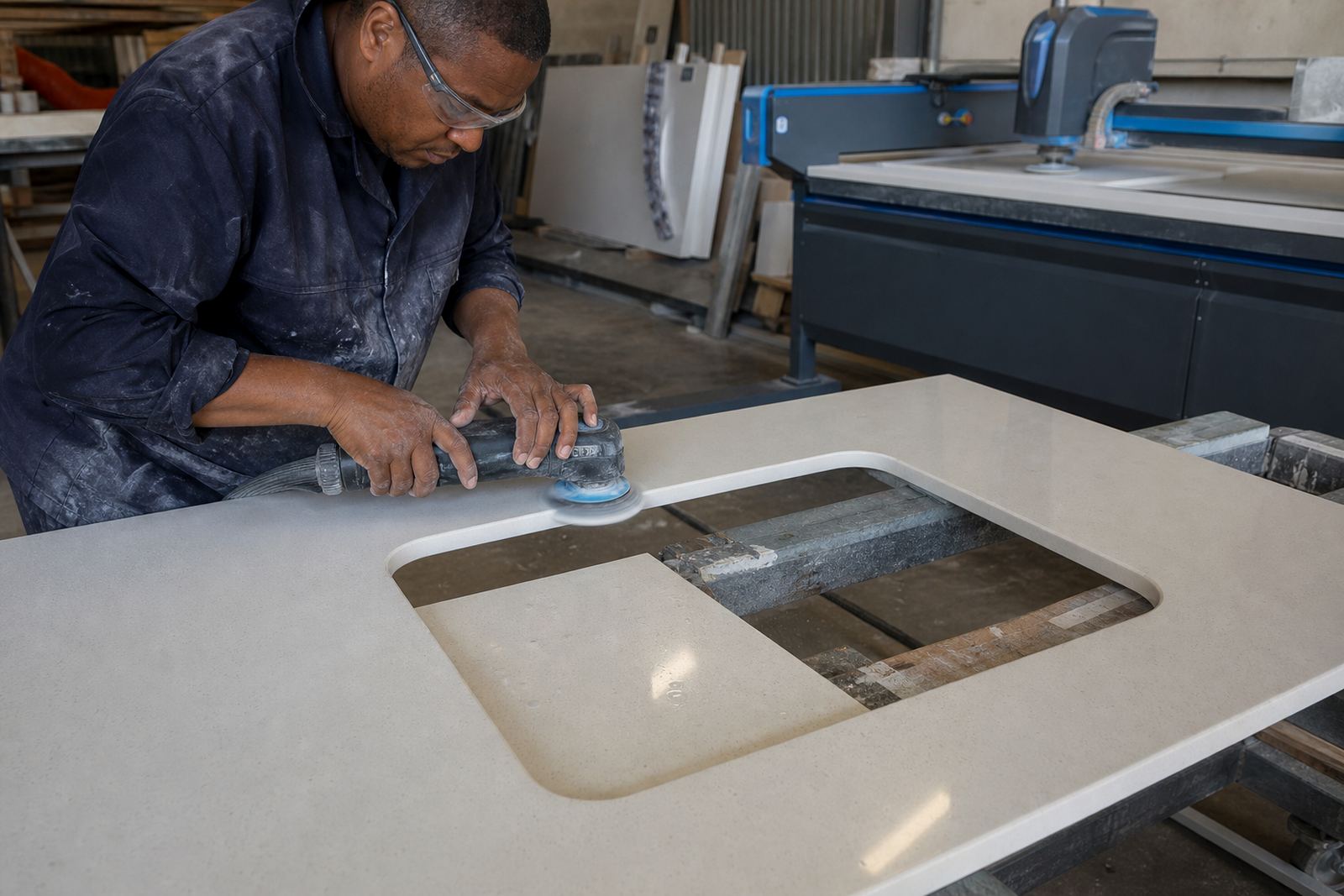
Engineered quartz waterfall ends are cut from the same slab where possible so colour and pattern stay consistent. The workshop will often mitre the visible corner so the side panel and top meet with a sharp architectural edge. Solid-surface waterfall ends can be joined, shaped and sanded to give a softer finish where a smooth visual line is preferred. The choice depends on the room style, slab format and the level of edge definition the client wants.
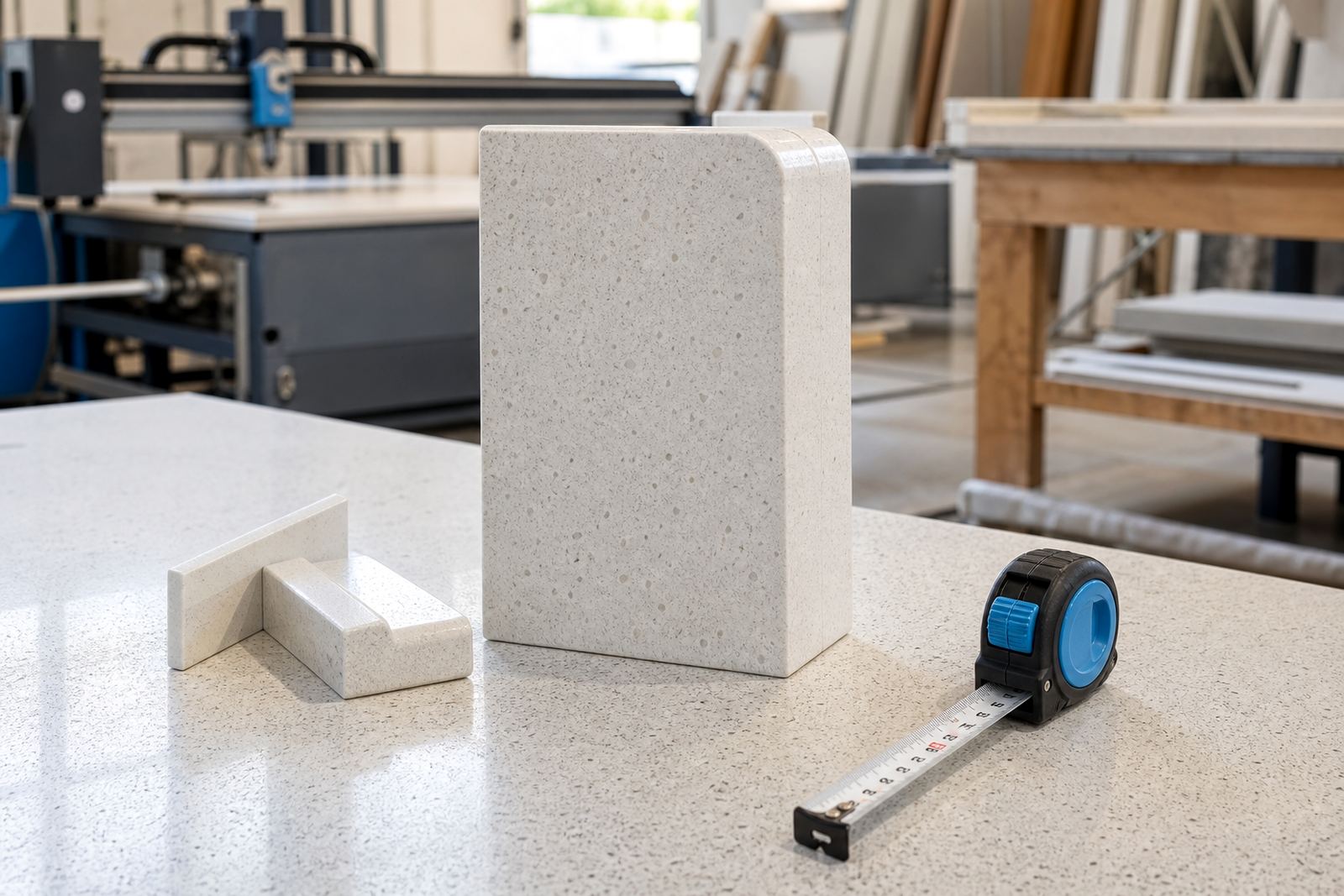
Material thickness affects the look as much as the dimensions. A 20 mm quartz slab gives a lighter line, while a built-up edge can make the island feel heavier and more substantial. On solid surface, the edge profile can be eased more freely, which helps in family kitchens and hospitality spaces where hands move across the corner often. The workshop also checks that the underside support is planned properly, because a waterfall return places weight and leverage differently from a standard flat top.
- Standard slab thicknesses commonly used are 20 mm and 30 mm.
- Mitred corners are common where a thicker visual edge is needed.
- Seams are planned to stay out of the most visible line where possible.
Installation details that keep the line straight
Installation starts with a final site check of cabinet alignment, wall lines and the floor level. The top and side are lifted, dry-fitted and set out before bonding, because a waterfall end has to read as one continuous plane from the seated side to the floor. If the island includes a sink, hob or breakfast ledge, the installer confirms the cut-outs and edge supports before the adhesive goes in.
In Gauteng homes and offices, transport and handling are part of the job because the side panel can be long, heavy and awkward to manoeuvre through tight passages or lifts. The fitting team needs enough working room to clamp, bond and clean the joint properly. If a waterfall end is wrapping a panel with a mitred corner, that corner must be protected during handling, especially on polished quartz where marks show fast under bright indoor light.
- Keep cabinets level and fixed before templating, not after.
- Allow access for large slabs through doors, passages and stair turns.
- Confirm if the waterfall end is one-sided, double-sided or paired with a waterfall return on another island face.
Daily care, heat and stain habits
Quartz and solid-surface waterfall ends are cared for like the rest of the countertop, with mild cleaner, a soft cloth and prompt wiping after cooking or food prep. For quartz, hot pans should not be placed directly onto the surface or the vertical return, because thermal shock can mark the resin content or stress the joint area. Solid surface handles everyday kitchen use well, but it still benefits from normal heat precautions and careful wiping around the seam line.
Spills from wine, turmeric, coffee, oils and acids should be cleaned before they sit, particularly where the end panel meets the floor and where the side face catches splashes from the prep zone. Matte finishes hide fine marks better than high gloss in some light, while gloss finishes need a softer cloth to keep swirl marks down. Over time, the aim is to protect the edge, the joint and the lower section where shoes, vacuum hoses and moving stools often tap the panel.
- Use a pH-neutral cleaner or warm water with a soft cloth.
- Avoid abrasive pads on the corner and seam line.
- Wipe the floor joint often, especially in busy kitchens and tea stations.
Details to confirm before fabrication begins
When ordering a waterfall end, the useful details are practical rather than decorative. Confirm the island length and depth, the slab thickness, the edge profile, the number of waterfall sides and whether the return should land flush or sit on a small plinth line. If the design includes sink cut-outs, hob cut-outs or a breakfast overhang, those features need to be shown on the template so the panel lengths and seam positions are correct.
It also helps to state whether the island is for a home, office or shopfitting job, because the traffic level changes the support and finishing choices. Our team in Strijdom Park handles site templating, digital measuring, slab layout planning, cutting and fabrication, edge profiling, seam joining, splashback fitting, countertop installation, vanity installation and aftercare advice across Johannesburg, Sandton, Midrand, Fourways, Pretoria, Centurion and Roodepoort. For a specific brief, use our contact form and include the room size, material preference and any cut-out positions already known.
- Island length, width and finished height.
- One-sided or double-sided waterfall detail.
- Material type, finish, edge style and cut-out positions.
Key facts
| Product type | Waterfall end panel for islands and feature counters |
|---|---|
| Material options | Engineered quartz or solid surface |
| Common slab thickness | 20 mm and 30 mm |
| Edge options | Square, eased, pencil round or mitred |
| Typical use | Kitchen islands, office counters and shopfitting displays |
| Service area | Strijdom Park, Randburg and Gauteng-wide installation |