

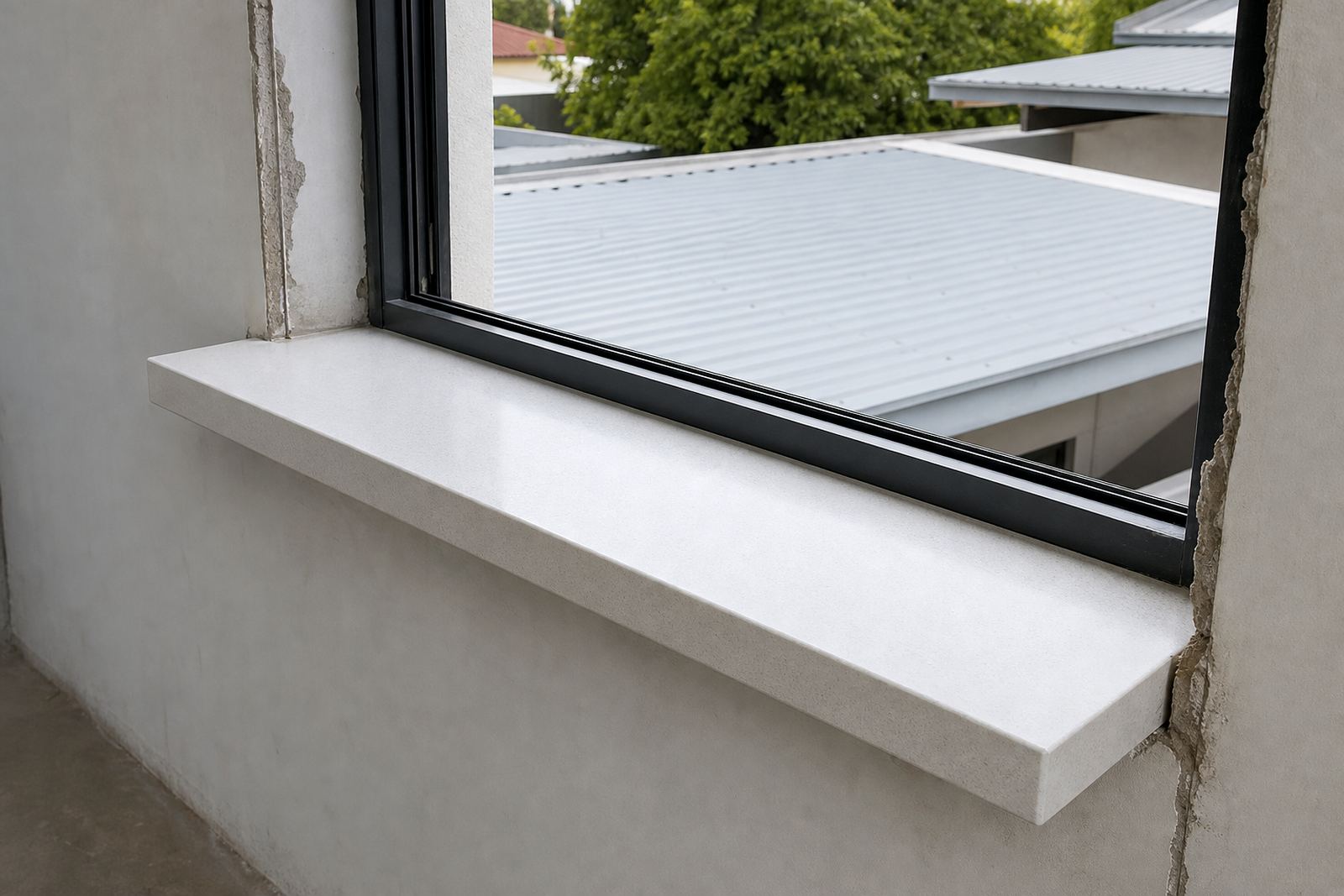
A cill that finishes the opening properly
A window cill is the finished horizontal surface set into or onto the inside edge of a window opening. In quartz, the cill is made from an engineered stone slab with a consistent colour body and a dense surface that suits kitchens, bathrooms, bedrooms and office spaces where a crisp finish matters. Solid-surface cills are also used where a warmer, more matte look is preferred and the detail needs to read as one continuous piece.
Most cills are cut from 12 mm or 20 mm material, depending on the visual profile and the build-up at the reveal. The front edge can be straight, pencil-rounded, eased, or slightly bullnosed where a softer line is wanted. For deep windows or recessed openings, the cill can be made in a wider single section or joined from carefully planned pieces with the seam placed away from the main viewing angle.
When a cill needs to sit neatly under tiled returns, paint lines or aluminium frames, the measurements need to be exact. That is where templating matters, because wall out-of-square, plaster nibs and frame tolerances show up fast at the finished edge. A good fit also leaves enough movement gap for sealant and prevents the stone from binding against the frame.
- Typical thicknesses: 12 mm, 20 mm and selected build-ups where the opening calls for a deeper edge.
- Edge profiles: square, eased, pencil-round, bullnose or a bespoke profile matched to the room.
- Finishes: polished quartz, honed solid-surface or a matt finish where glare needs to be reduced.
- Edges can be overhung slightly past the wall face for a clean drip line and easier wiping.
Where quartz and solid-surface cills earn their keep
These cills suit wet rooms, sunlit rooms and places that get regular wiping. In bathrooms they cope well with splashes from basins and condensation around windows, while in bedrooms and living areas they help protect painted plaster from scuffs, flowerpot stains and everyday dusting. In offices and reception areas, the surface gives a tidy finish that reads properly beside blinds, frames and cabinetry.
Quartz is often specified where there is stronger wear, stronger sunlight or a need for a harder-faced surface with tighter colour control. Solid-surface works well where the opening calls for a more shaped edge or where the cill needs to visually blend with adjacent vanity tops or shelving. Both materials can be cut to suit bay windows, narrow reveals, deep sills and long runs that cross several openings.
For shopfitters, the repeatable nature of fabricated stone is useful when several cills must line up across a fitted counter wall, display bay or partitioned office zone. In homes, the value is usually in the small details: a neat return into the reveal, an even overhang, and a finish that still looks deliberate when the curtains are open and the sunlight is harsh.
- Suitable for bathrooms, bedrooms, offices, reception areas and upper storey rooms with strong sun exposure.
- Works with painted surrounds, tiled reveals, timber frames and aluminium window systems.
- Can be colour-matched to counters, vanities or splashbacks for a continuous room detail.
The fitting sequence from template to final set
Window cills are normally installed after the opening has been measured on site and the surrounding finishes are far enough along for a final template. The template captures the full shape of the reveal, the depth of the wall, frame projections and any awkward corners. After that, the slab is laid out in the workshop so the best section of material faces the room, and any seams are planned where they will be least visible.
Cutting and fabrication cover the straight lengths, returns, mitres where needed, and any sink or tap-related openings if the cill forms part of a vanity wall assembly. In most cases, the cill is fixed on a prepared bed or with suitable support points, then sealed at the perimeter so moisture cannot work into the joint. Where a window frame sits low or the wall finish is uneven, packing and final scribing help the stone read as one clean line.
Installers also check how the cill meets nearby trims, blinds and roller mechanisms so the finished piece does not catch or interfere with daily use. If a room has multiple windows, consistent projection and height matter, especially where natural light shows every small mismatch. That is the difference between a cill that merely fits and one that looks settled in place.
- Site templating records the opening shape, frame depth, reveal size and any out-of-square walls.
- Workshop fabrication includes cutting, edge profiling, polish or honing and seam planning.
- Installation may include support packing, adhesive bedding and perimeter sealing.
- Final alignment checks cover projection, level, wall contact and neat junctions to the frame.
Care where sun and moisture share the same wall
Quartz and solid-surface window cills are straightforward to keep clean, but they still need sensible care. Dust, cleaning spray residue and water marks are best removed with a soft cloth and a mild cleaner suited to stone or solid-surface finishes. Harsh pads can mark the sheen, and rough scrubbing near the edge may dull the profile over time.
Heat from strong sun on a deep south-facing opening can put stress on seals and adjacent trims, so it is worth checking the perimeter from time to time. In bathrooms and kitchens, standing water should not be left sitting at the joins for long stretches, especially around frames and tiled returns. A dry wipe after cleaning keeps the line crisp and stops mineral marks from building up.
Solid-surface is forgiving if a light surface mark appears, while quartz is valued for its dense, sealed character and stable finish. Neither should be treated as an indestructible ledge for hot trays, sharp tools or heavy plant pots. The cill is there to finish the opening properly, and a little care keeps it reading as intended.
- Use a soft cloth and a mild cleaner made for finished stone or solid-surface surfaces.
- Avoid abrasive scouring pads, bleach-heavy mixes and sharp metal scrapers.
- Lift heavy planters rather than dragging them across the edge.
- Check sealant lines after long wet seasons or after repainting nearby walls.
Measurements that need to be pinned down before fabrication
For a window cill to fit properly, the order details need to be exact. We need the opening width and depth, the number of windows involved, the material choice, the preferred edge profile and the finished face height relative to the surrounding wall or tile line. If the cill is joining a vanity wall, splashback or fitted cabinetry, those adjacent dimensions must be included too.
It also helps to know whether the opening is square, whether there are tiled reveals, whether blinds sit tight to the frame and whether the cill must line through several rooms. Where sunlight is intense or the room faces weather exposure, the finish selection matters, because some colours show dust and water marks more quickly than others. We also look at the intended use, since a child’s bedroom window or a busy office bay may need a different edge treatment from a quiet lounge.
Clients in Gauteng usually get hold of us through our contact form on our contact page, and that is the simplest place to send the room measurements and any photos of the opening. From there, the workshop can plan slab use, seam positions and fitting detail for the job. For larger runs or mixed-room work, one measured note saves a lot of back-and-forth on site.
- Opening width, depth and finished height from the floor or surrounding surface.
- Material choice: quartz or solid-surface, plus colour and finish preference.
- Edge detail, overhang and any return into tiled or painted reveals.
- Whether the cill is standalone, part of a vanity wall, or part of multiple openings.
Key facts
| Material options | Engineered quartz or solid-surface |
|---|---|
| Common slab thickness | 12 mm and 20 mm |
| Edge profiles | Square, eased, pencil-round, bullnose |
| Fabrication work | Templating, cutting, seam planning, edge profiling |
| Installation areas | Strijdom Park, Randburg and across Gauteng |
| Typical use | Bathrooms, bedrooms, offices, reception areas, window bays |