
Where the tap body has to sit on the top
The first decision is not the hole itself, but the space around it. On engineered quartz and solid-surface tops, the tap must sit far enough from the basin rim to leave room for the fixing nut, supply hoses and a hand to get in underneath during installation. If the basin is close to the back edge, the hole can end up too tight against the wall or splashback, and that makes sealing harder. On a vanity in Sandton, for example, the basin shape, mirror line and wall tiles all affect where the tap lands, not just the countertop size.
A few millimetres can change the fit. That matters even more on narrow utility tops, where the installer has less room to work around the sink cut-out and the backsplash. We always look at the full top, not only the tap centre point.
What the basin or sink shape changes
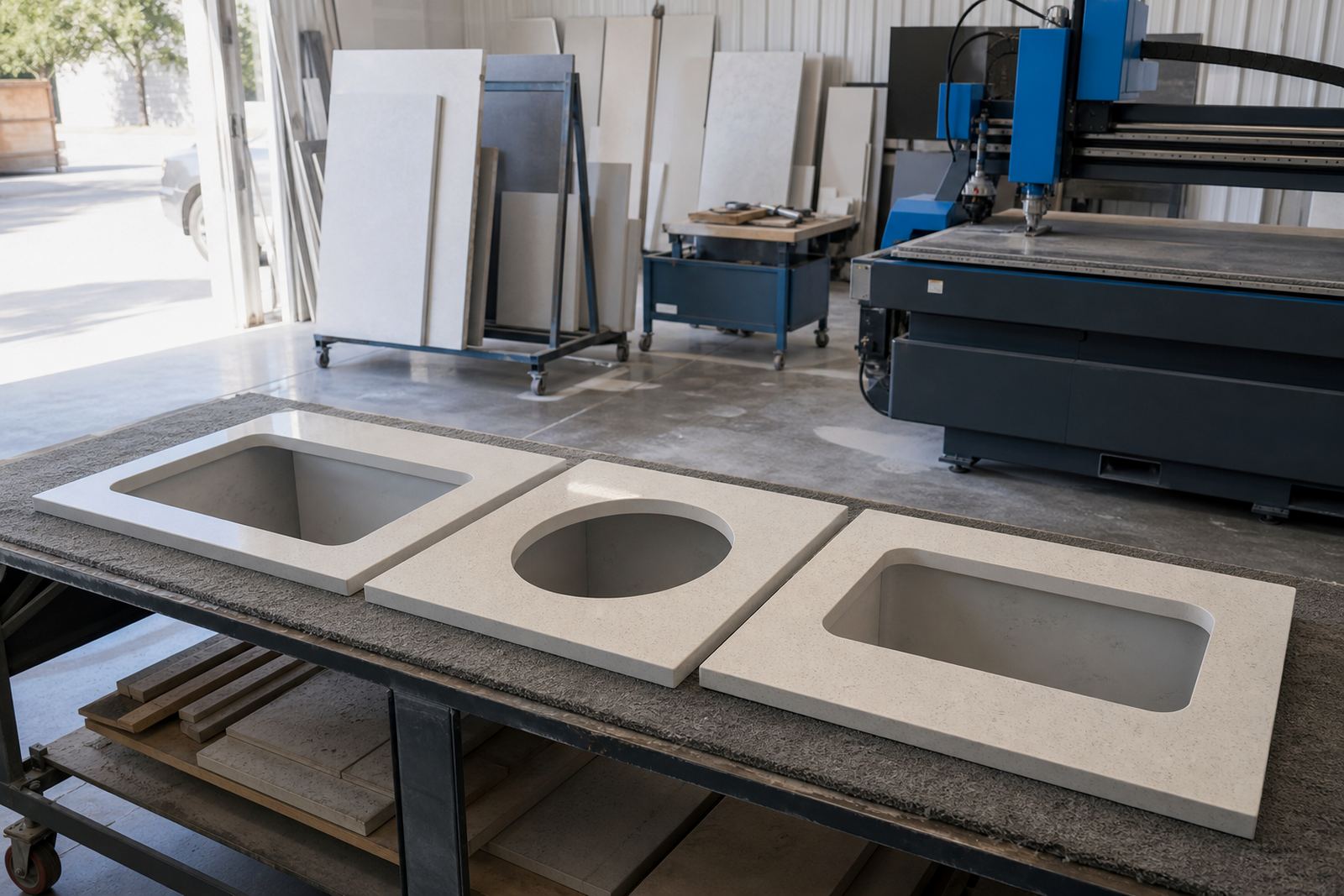
Inset basins, undercount basins and utility sinks all ask for different clearances. A round basin often gives more freedom, while a rectangular bowl can push the tap position left or right depending on the overflow and rear lip. For a vanity with a centre basin, the tap usually sits on the back deck. On a utility top, it may need to move to one side so the user can reach the bowl without the spout hanging awkwardly over the edge.
- Rear rims need enough flat surface for a neat seal.
- Oval bowls give more room than square basins in tight widths.
- Large utility sinks may need the tap offset for better reach.
- Under-counter basins leave more visible deck, but the underside still needs clear fixing space.
Slab thickness, edge detail and the drill line
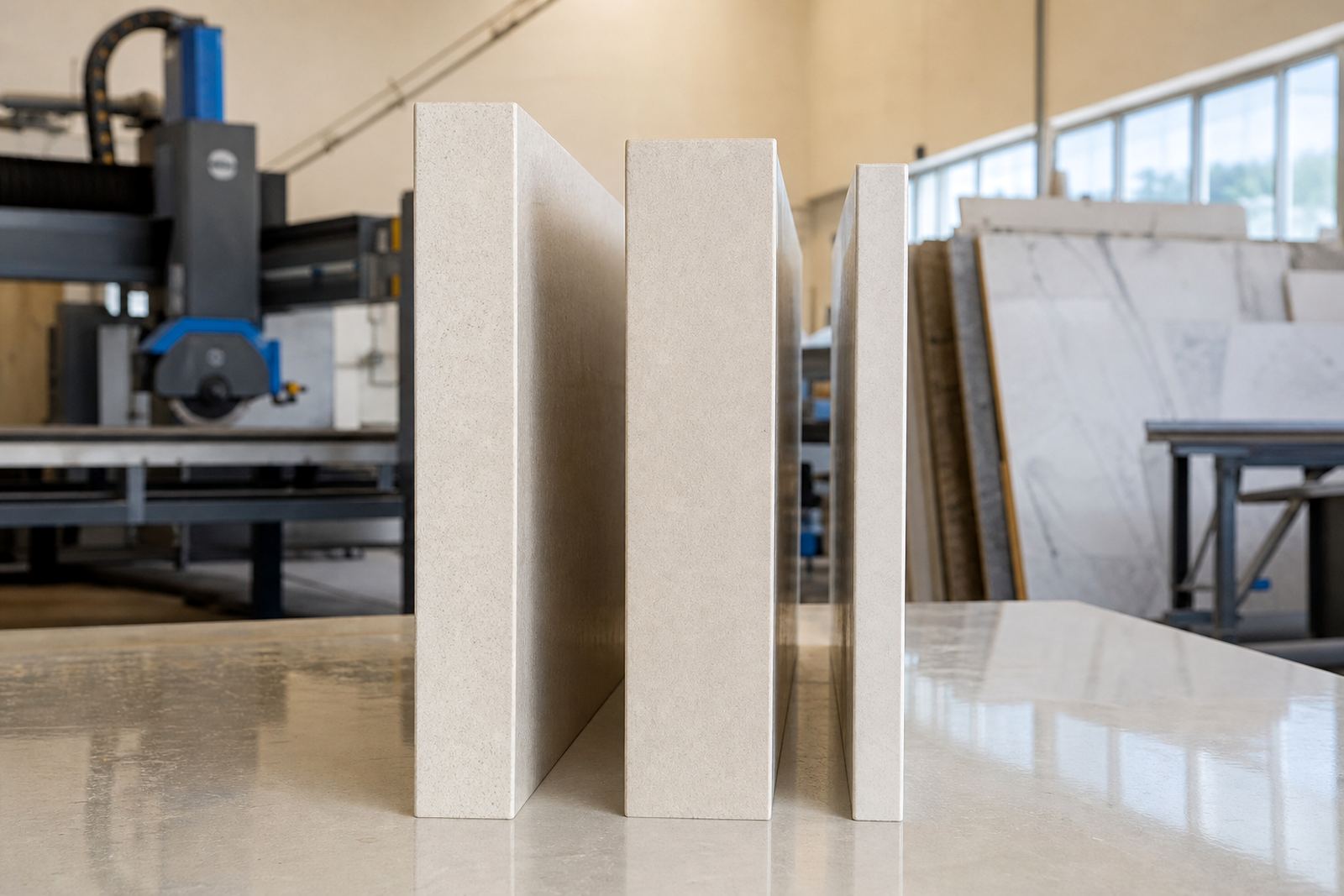
Engineered quartz and solid-surface tops do not behave the same way when drilled, even though both can take clean tap holes. The slab thickness, usually around 20 mm or similar project sizes, changes how much support sits around the opening. A pencil edge, square edge or more decorative profile also affects the visible position of the hole. If the edge detail is thick, the tap may need to sit slightly further back so the handle clears the front line properly.
On some installations, the challenge is not the hole diameter but the relationship between the hole and the finished edge. If the tap is too close to a rolled or shaped splashback, the handle can strike the wall before it opens fully. We check the template first, because any cutting must wait until the measurements are right.
Seam lines, splashbacks and the back wall
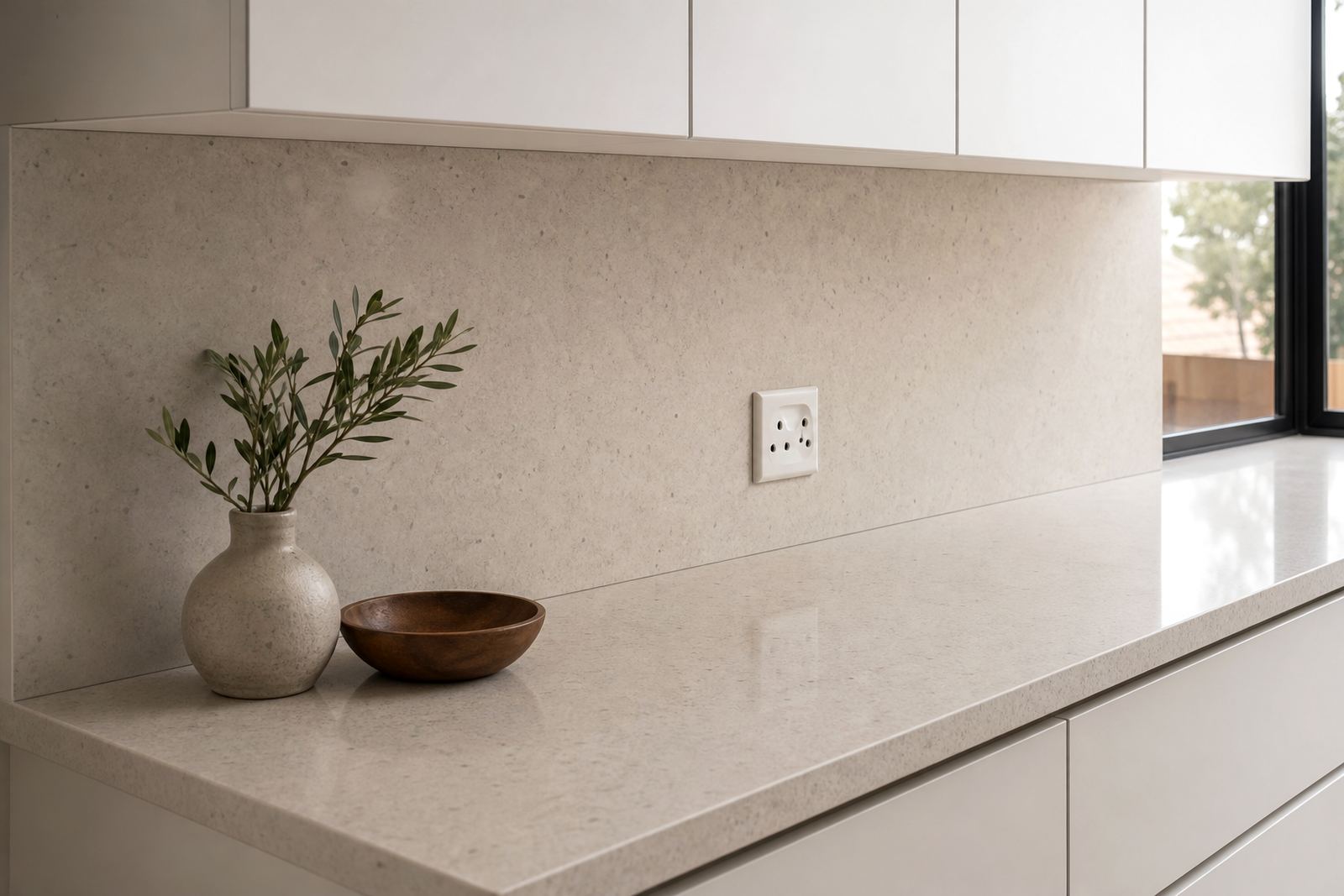
Tap hole positioning also has to respect seams and joints. A seam close to the tap can weaken the visual balance of the top, and in a busy wash area it can make the area look crowded. On longer vanities, the tap may be shifted slightly so the seam lands in a quieter section of the slab. On a splashback, the tap opening must line up cleanly with the backsplash joint so silicone can finish neatly.
- Keep tap holes clear of seam joins where possible.
- Check that the splashback does not block the handle sweep.
- Leave enough room for silicone around the tap base.
- Match the hole position to tile joints where the design calls for it.
In Pretoria offices and clinic-style washrooms, that neat alignment often matters as much as function. Staff notice when the tap centre, basin and splashback all read in one line.
Heat, staining and daily use around the opening
Tap holes sit in one of the most used parts of the top, so the surrounding surface must be sealed and cleaned properly. Quartz resists staining well, but standing water, soap residue and metal fittings can still leave marks if the area is not wiped down. Solid-surface tops are forgiving, though they still need sensible care around hot kettle splash, hair product spills and cleaning chemicals. The tap base should not trap moisture under a loose rosette or cover plate.
In kitchens and utility rooms, the tap position should also help the user avoid splashing the front edge. A tap set too far forward throws water onto the floor and onto cabinet doors. Too far back, and it becomes awkward to wash hands or fill containers.
What we look at during templating in Gauteng
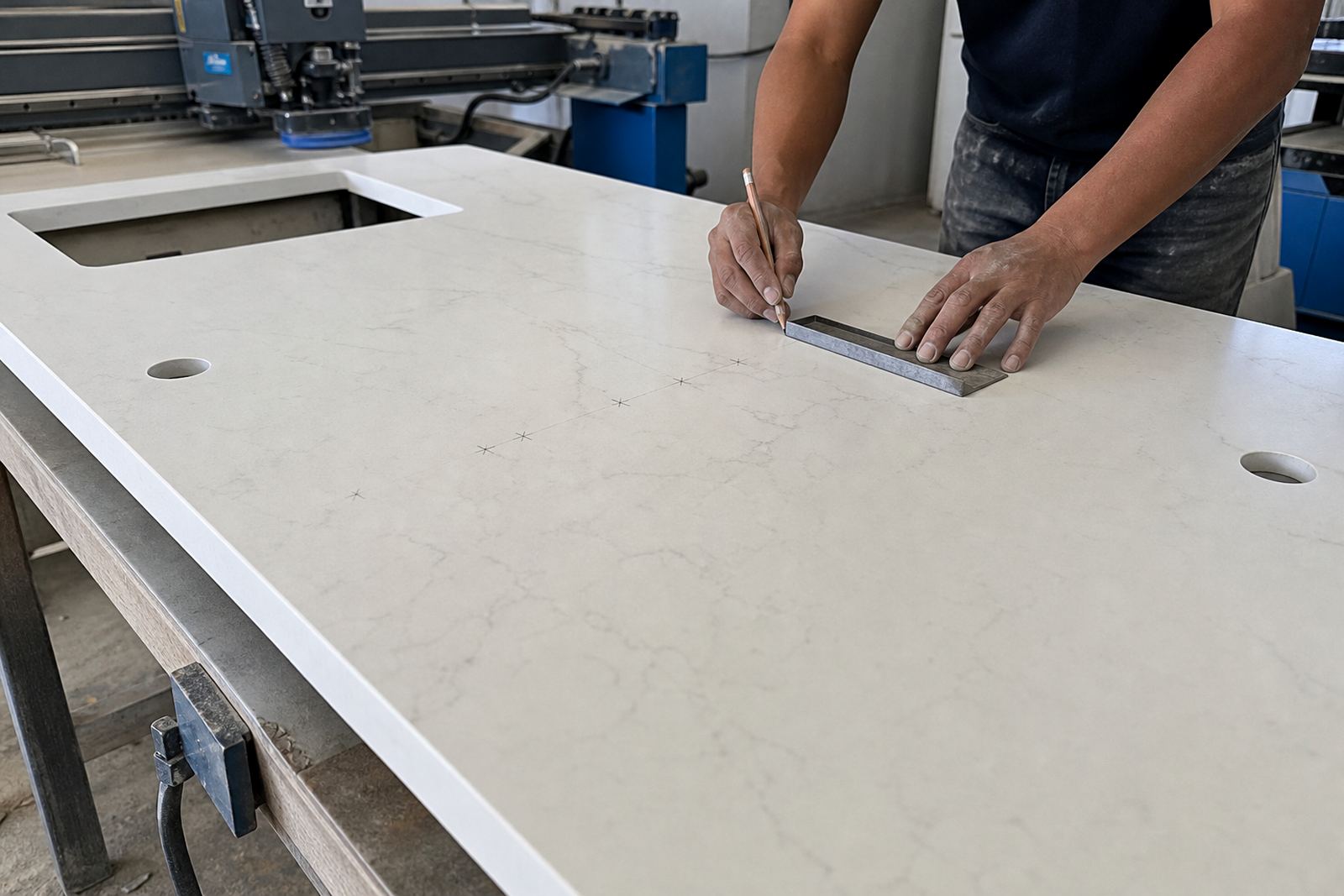
At our Strijdom Park workshop in Randburg, tap hole work starts with accurate templating and digital measuring. The templater checks the basin, the deck width, any side splashes and the wall finish before the slab is cut. That keeps the hole position linked to the real site, not only the drawing. For homes in Fourways, offices in Midrand and shopfitters in Johannesburg, the same principle holds: measure the fixtures first, then cut the opening.
Practical site checks usually include:
- Distance from the basin centre to the back edge.
- Room for tap handles, especially mixer styles.
- Clearance for hoses and fixing hardware underneath.
- Alignment with wall tiles, mirrors or shelves.
- Access for final sealing and aftercare cleaning.
Randburg vanity tap hole positioning
A recent vanity in Randburg had a slim quartz top, a wide basin and a tiled splashback with a strong grout line. The first layout put the tap too close to the rear edge, and the handle would have struck the tile during use. The final position moved the hole forward by a small margin, which kept the line of the vanity clean and left enough room for the rosette and sealant. That small shift improved daily use without changing the look of the bathroom.
That is usually the pattern. Tap hole positioning is not about one fixed number, it is about the basin, the slab, the edge and the real use of the room. When those parts are checked together, the finished top feels planned rather than forced.