
Illovo brief, tight corners and busy hands
The client was a salon team in Illovo, working in a compact commercial space where the counter had to serve reception, stock handling and practical wash-area use. The layout needed a surface that looked sharp in front of clients, but also carried the knocks that happen when bowls, bottles, towels and tools move through the day.
The brief centred on engineered quartz for the public-facing counter and solid-surface sections where a warmer, more forgiving finish made sense around the wash area. We planned the run to suit the room, the service flow and the existing wall lines, because a salon counter cannot afford awkward returns or joints that trap moisture and debris.
Access was tight and the install had to work around the salon's trading pattern. That meant detailed templating, careful edge decisions and enough site planning to keep the finished tops neat around corners, door swings and fixed fittings.
Material choices that suited the daily use
For the main counter surfaces, the slab thickness was selected for a stable look and practical strength, with finished edges detailed to suit the client-facing front. We used a simple square edge on the most visible sections, then softened some exposed corners to reduce impact damage where staff would be moving past with trays and tools.
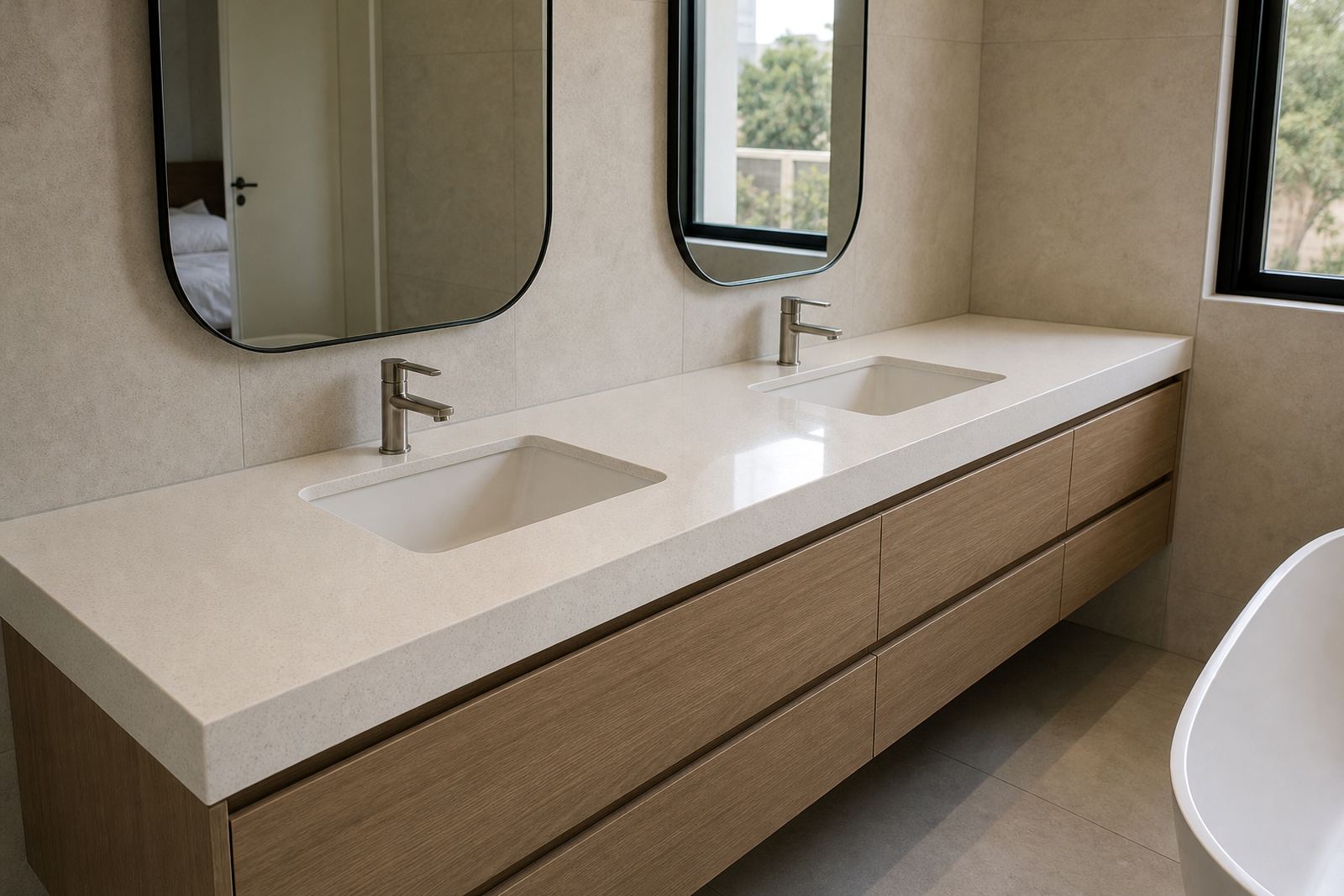
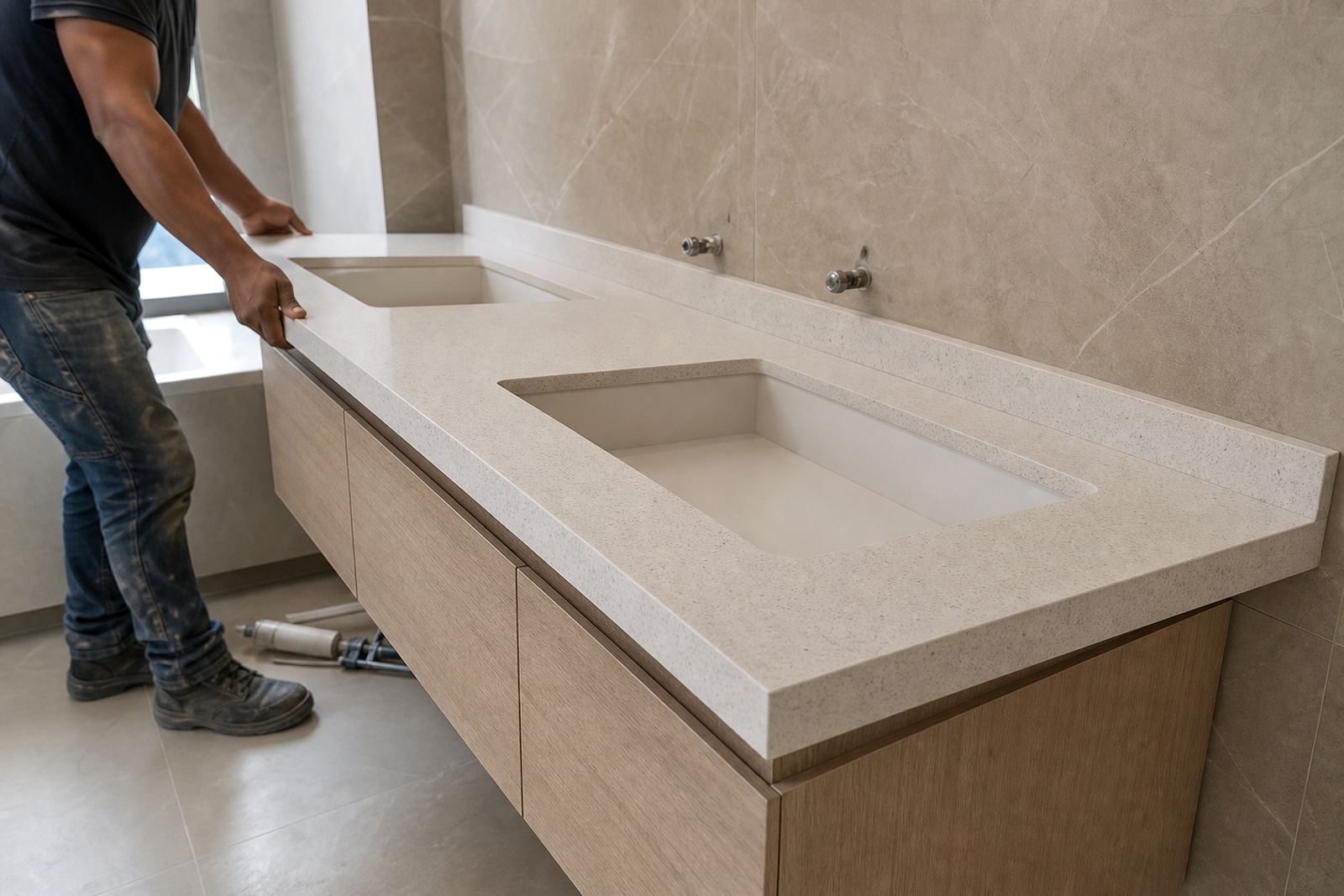
Sink cut-outs and service openings were planned from the start, not cut as an afterthought. The wash-area tops needed clean clearances around basins and tap positions, with the joins set where they would be least obvious and least exposed to standing water. Seam placement matters in a salon, because one badly set joint draws the eye and collects grime.
Surface care was part of the material decision too. Quartz gives good stain resistance when spills are wiped off, while solid-surface sections can be shaped with smoother transitions in areas that need easier cleaning. Heat protection was discussed as well, because hot styling tools should not sit directly on any countertop without a proper rest point.
From template to workshop floor
Johan handled the on-site templating, measuring the counter run, returns, support points and final clearances against the actual room. Digital measuring helped us confirm the shape before cutting, and it reduced the chance of surprises at install stage, especially where the existing walls were not perfectly square.
In the workshop, the slabs were laid out to control grain movement and visual balance across the faces. Cut-outs were formed for the sink positions, finishing allowances were checked against the templates and the edge profiles were machined to the agreed detail. Where needed, seam joints were dry-fitted and checked for line, height and colour match before final joining.
- Site templating for the full counter run and wash-area sections
- Digital measuring to confirm corner angles and offsets
- Slab layout planning to manage the visible pattern and cut sequence
- Cutting and fabrication with edge profiling and sink cut-outs
- Seam joining set for the least visible positions
Installation in a working salon
Candice coordinated the installation sequence so the tops could be brought in, set and fixed with minimum interruption to the salon floor. The old surfaces had to be cleared, the base lines checked and the new sections seated accurately before any final finishing work started.
At installation, the team checked level across the full run, sealed the relevant joints and made sure the splashback lines sat neatly against the wall finish. Around the wash area, the fit needed to be tidy enough to handle cleaning water and daily spray without leaving open edges or rough corners. A salon is not a quiet room, and the work had to fit around people moving in and out, so the sequence mattered as much as the material choice.
We also left the client with aftercare advice specific to engineered quartz and solid-surface tops. That included stain care, the right cloths for routine cleaning and the sensible use of heat protection near styling tools. No one wants polished surfaces dulled by the wrong cleaner or edge chips from hard knocks near the basin zone.
The finished counter under daily pressure
The completed installation gave the salon a cleaner front-of-house look and a more practical wash area. The counter line reads straight, the joints are controlled and the surfaces now support the pace of a commercial day without looking patchy or overloaded.
What stood out after handover was the way the material choice supported both appearance and upkeep. Quartz gave the reception side a crisp finish, while the solid-surface areas helped where water and regular wipe-downs are part of normal use. The result was not about showpiece styling, it was about a counter that could take a steady working rhythm and still present well to clients.
- Cleaner join lines and better wall-to-top transitions
- More practical basin areas for water splash and daily wipe-downs
- A counter finish that suited both reception use and wash-area work
- Improved edge protection on exposed corners
What we bring into a comparable salon fit-out
We would approach a similar project with the same order: measure properly, confirm service positions early and keep seam placement tied to the room layout rather than trying to force it later. In salon work, small setting errors become visible very fast, so the template stage has to be exact and the workshop stage has to stay disciplined.
We keep finish details practical, especially for coastal homes or humid spaces where materials can wear faster. A square edge works well in many front-of-house areas, but softer corners are useful where staff pass close or where bags and tools are likely to knock the front face. On any counter near water, the wall junctions, basin cut-outs and splashback lines need as much attention as the visible top surface.
For commercial clients in Johannesburg, Sandton, Midrand and Pretoria, the same rules keep repeating: plan the room, respect the service points and finish the surfaces so they stay easy to clean. That is the part that makes the work hold up after opening day is long gone.
Key facts
| Project | Illovo Salon Counter |
|---|---|
| Client type | Salon team |
| Town | Illovo, Johannesburg |
| Scope | Service counter, wash-area tops and splashback work |
| Materials | Engineered quartz and solid-surface tops |
| Work stages | Site templating, cutting, fabrication, installation and aftercare advice |