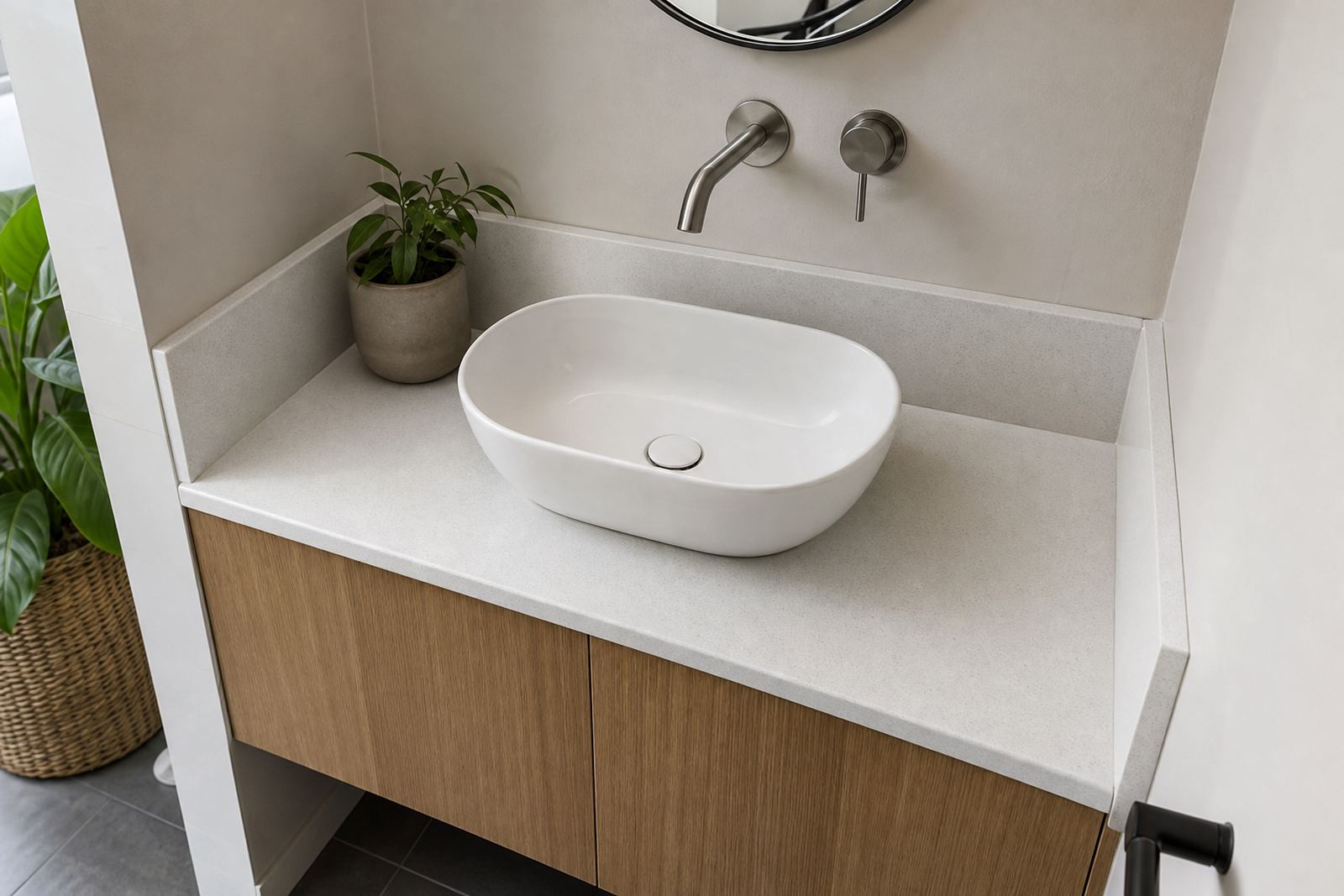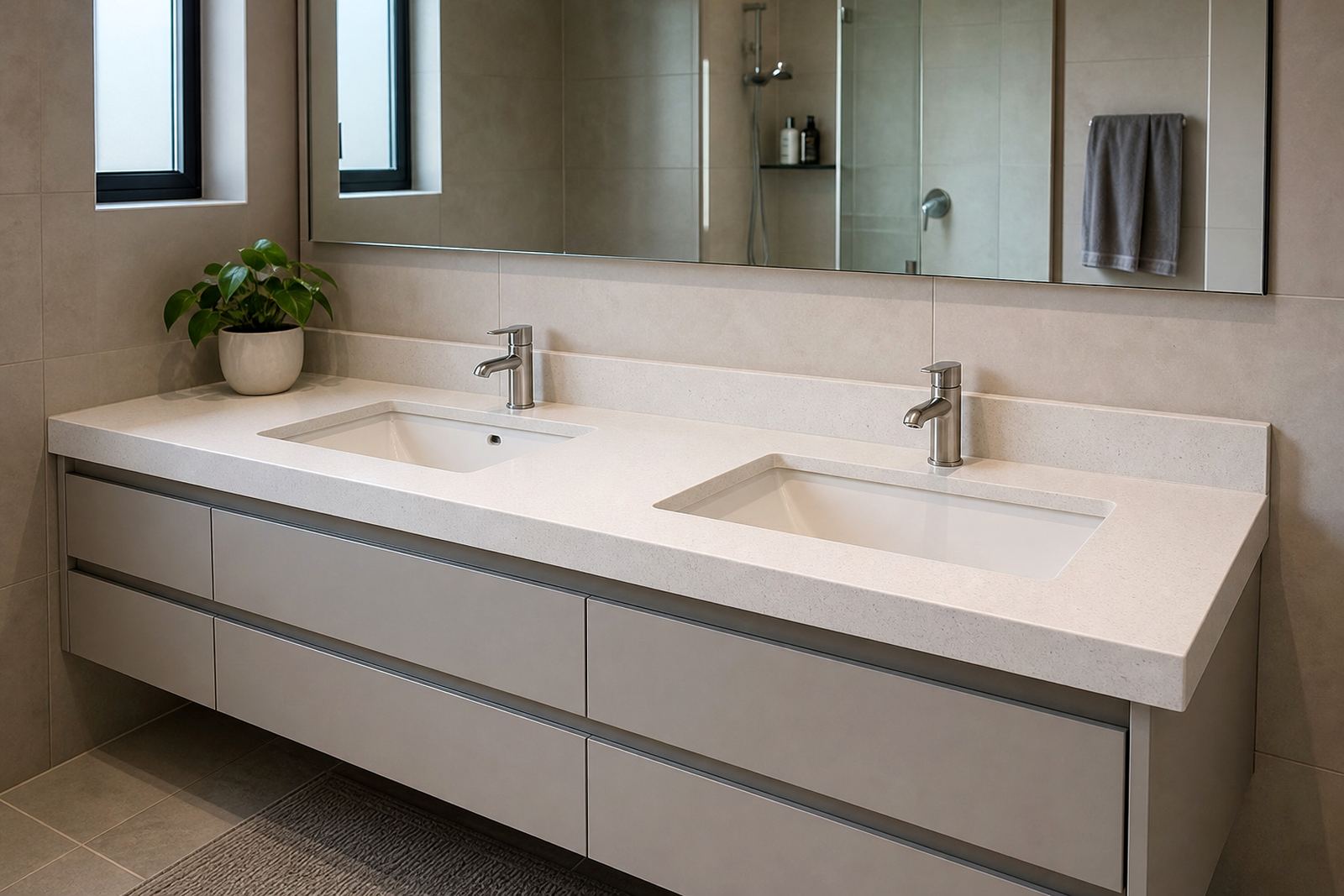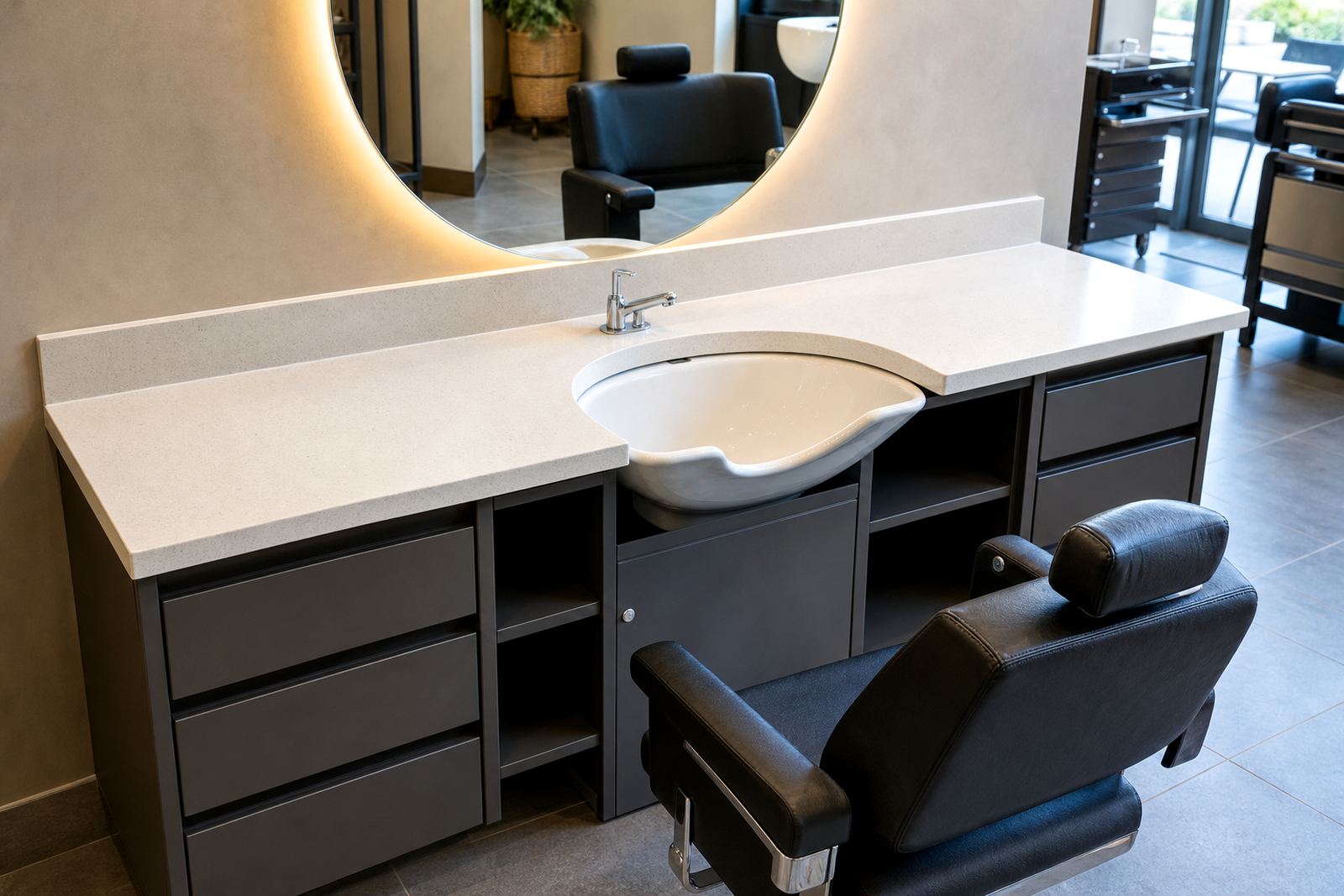
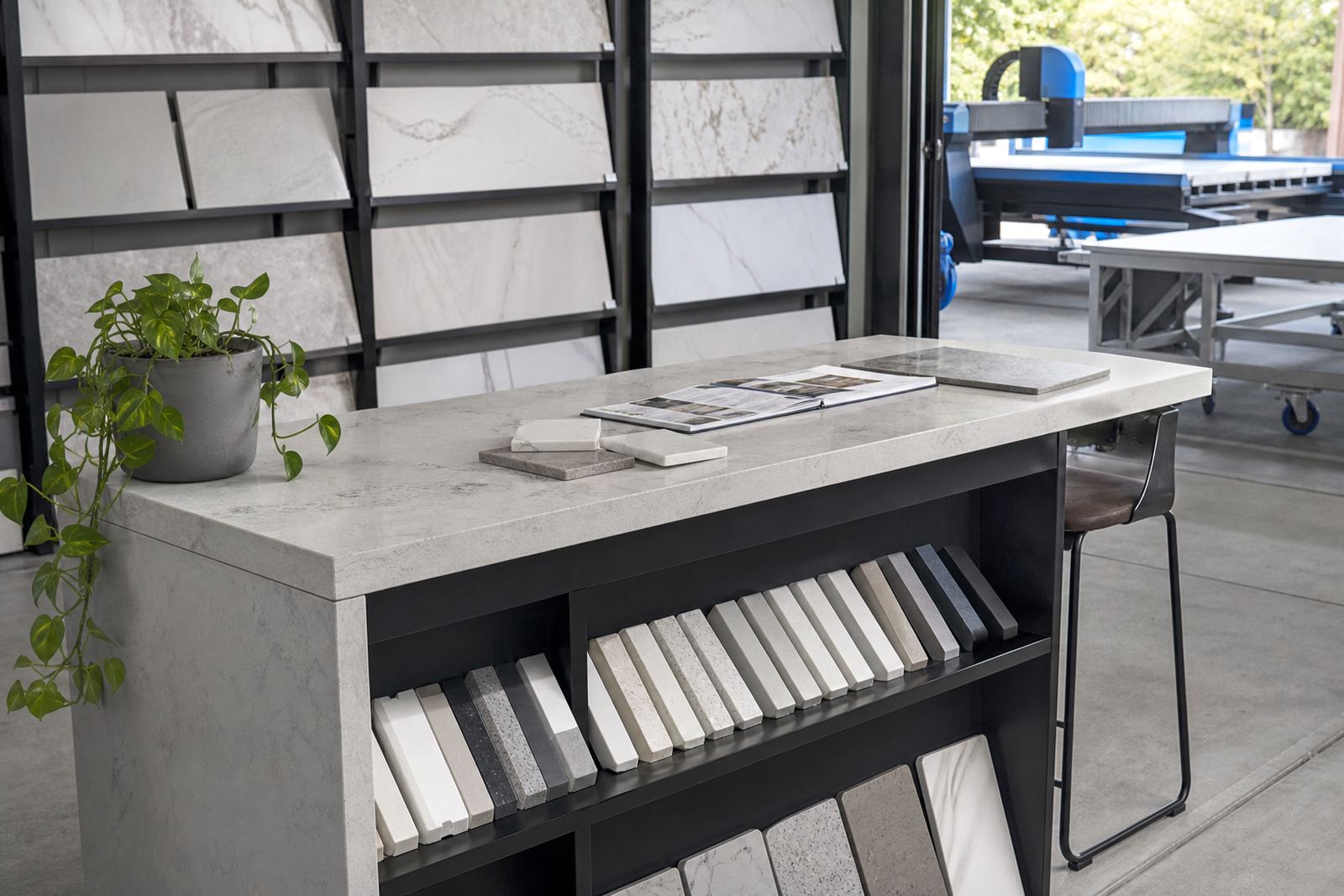
Counters that have to work through trading hours
A retail counter is never only a top. It is a work surface, a payment point, a display edge and often the first surface customers lean on. For that reason the build needs to handle trolley bumps, cleaning chemicals, bags, keys and the steady rubbing that comes with ordinary trade.
Engineered quartz suits counters that need a hard, low-porosity finish and a crisp look across long runs. Solid-surface works well where shaped fronts, integrated details or easier repairs are part of the brief. Both can be made in practical slab thicknesses, then strengthened where the counter overhangs or where staff lean during a busy shift.
What the workshop plan must settle early
The best retail counter starts with measurements that reflect the real shop, not a rough sketch. We template on site so joins, wall angles, plug positions and uneven floors are captured before cutting starts. That reduces surprises when a counter must fit between a till point, a display wall and a back-of-house opening.
We plan the slab layout around visible faces and seam placement, then set the edge profile to suit the trade. A square edge gives a neat modern line. A softened pencil edge is easier on hands during long use. For shops that want more presence, a thicker built-up edge can make a counter look heavier without wasting full slab material.
A retail finish that survives cleaning and handling
Daily cleaning is a big part of retail counter life, especially in food, beauty, pharmacy and clothing spaces where the top gets wiped many times a day. Quartz resists staining well when spills are cleaned promptly. Solid-surface can be renewed more easily if a section gets marked or scratched. Both need sensible care, not rough scourers and harsh heat.
Hot cups, straighteners, tools and disinfectants all deserve a bit of control at the counter. We advise on safe resting points, trim details that do not trap grime, and corners that are easy to wipe. A well-made counter should leave no crumb traps at the front edge and no awkward pocket behind the till where dust settles out of reach.
- Non-porous finishes help with routine wipe-downs
- Seams should be tight, level and kept out of heavy traffic points
- Rounded internal corners are useful where staff clean fast
- Matte and satin looks can hide fingerprints better than polished faces
- Heat care matters around coffee machines, steamers and hot tools
Common errors that make shop counters harder to live with
Retail counters go wrong when the design is based only on appearance. A counter can look neat on paper and still be awkward if the till tray sits too high, the customer ledge is too deep, or the staff side has no knee space for seated work. Another common mistake is fitting a fine finish over an uneven base, which leads to visible lines and unhappy joins.
We also see counters built without enough room for cable routes, receipt printers or safe storage below. If the edge overhang is too long without support, the front can feel brittle. If splash protection is skipped behind handwash points or coffee stations, water marks and swelling become part of daily maintenance. Small planning errors tend to show up fast in retail because the counter gets used all day, every day.
Budget ranges for retail counter work in Rand
Retail counter pricing depends on material choice, total length, edge profile, cut-outs, splashback height and the number of joins. A small straight counter for a compact shop can sit in a lower range, while a longer L-shaped or wraparound piece with special detailing will move higher. Site conditions also matter, especially where old flooring is uneven or the counter has to fit around existing fixtures.
As a working guide, straightforward retail counters often start around R12 000 to R25 000 for simpler runs. Mid-range jobs with better edging, cut-outs and more length commonly sit around R25 000 to R55 000. Larger shop counters, reception-style pieces or mixed layouts with returns, splashbacks and detailed finishing can move beyond R55 000, depending on the final specification.
That range is there to help a shop owner or fit-out team plan the brief without guessing. A clear drawing, site photos and measurements help the estimate land in the right band before templating begins.
From Strijdom Park to the shop floor
Our workshop in Strijdom Park handles retail counters for Johannesburg, Sandton, Randburg, Midrand, Fourways, Pretoria, Centurion and Roodepoort. The work often starts with a site visit, then templating, slab layout planning, cutting and fabrication, edge profiling and final fitting on site. For shopfitters, that sequence keeps the counter aligned with the rest of the fit-out, not floating as an afterthought.
Morne Moonsamy leads the business, with Lebo Mokoena on operations, Ayesha Naicker on estimating, Johan Ngwenya on templating, Sibusiso Mdlalose in the workshop, Candice Mthethwa on installations planning and Thabo Rademeyer handling aftercare advice. That mix helps when a retail job needs a practical handover, not just a finished surface. Send the counter size, site address and preferred finish through our contact form, and we plan the fabrication and fitting from there.