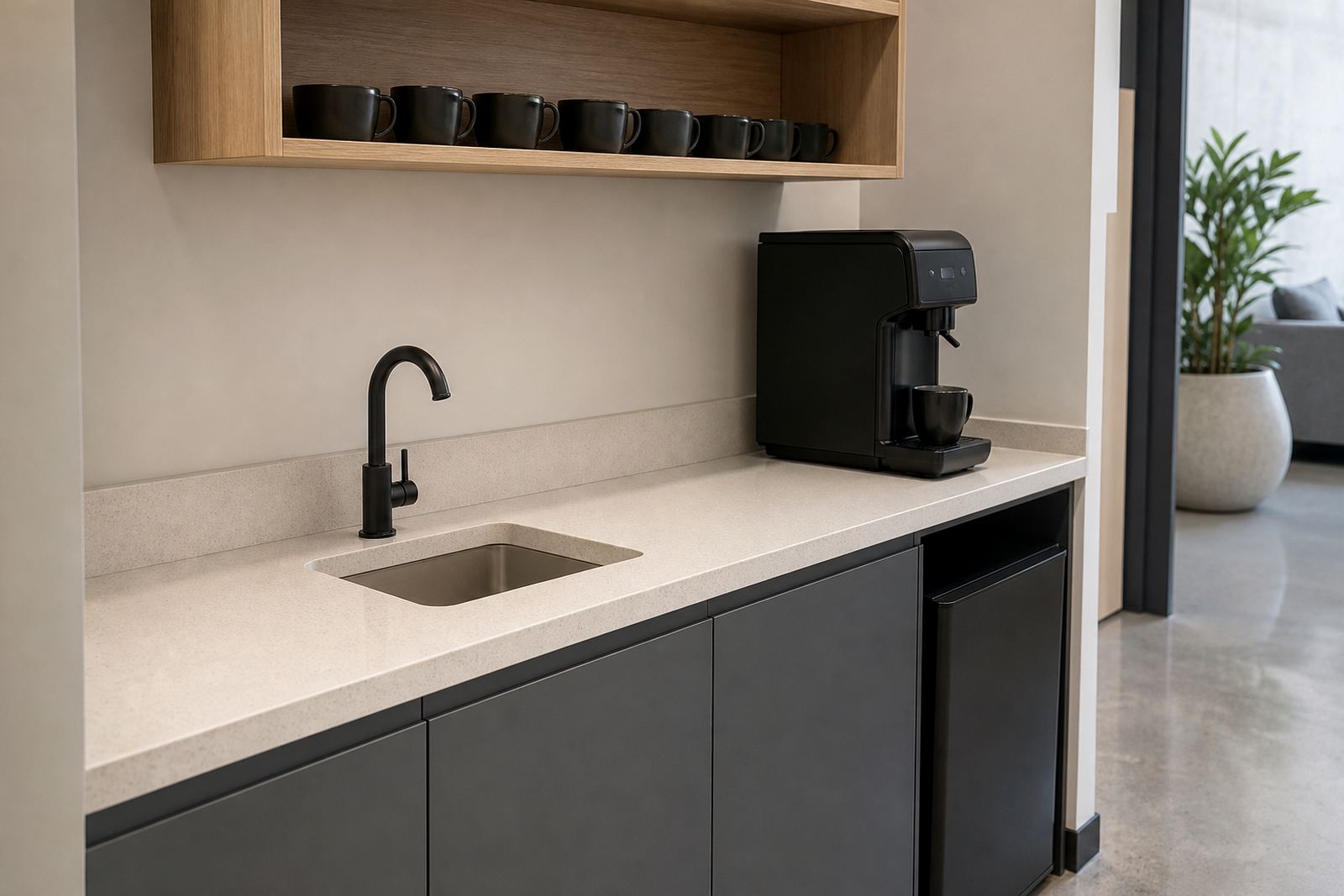
What a tea station has to handle every day
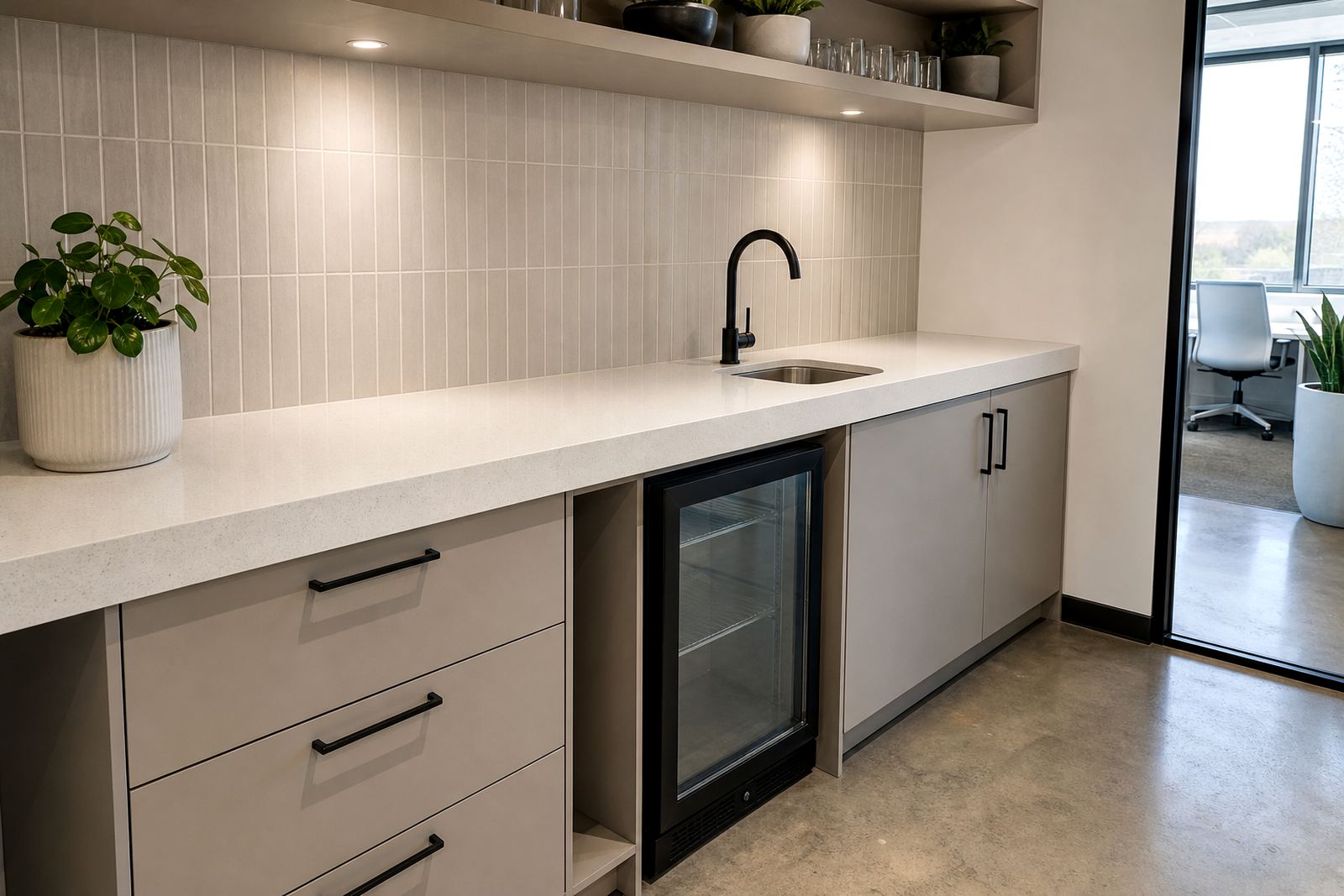
A good tea point is usually a small work zone with a sink, kettle, microwave or coffee machine, a drip area and somewhere for cups and tins. In offices and shopfronts it often sits near a corridor or reception wall, so the surface must handle traffic and still look tidy after a busy morning. Engineered quartz suits these spaces well because it is dense, stain resistant and available in slab thicknesses that work for both slim modern tops and heavier looking profiles. Solid-surface is useful where a joined appearance matters and a fully integrated sink apron or curved detail is needed.
The main job is not decoration, but standing up to daily wear. Water around a sink, heat from kettles and the odd tea stain around a splashback need a surface that can be cleaned without fuss. Small marks and chips at the front edge are also more visible on a tea station than in a back room, so edge choice and seam placement matter from the start.
Typical equipment we allow space for
Tea stations are often compact, but the equipment list grows quickly once staff start using the area properly. We plan around the actual appliances and the clearances they need, not just the footprint on a plan. That avoids awkward tap positions, cramped splashbacks and cut-outs that sit too close to a corner.
- Single or double bowl sink with drainer space
- Kettle, capsule machine or filter coffee machine
- Microwave, undercounter fridge or water dispenser
- Wall tiles or splashback panels behind the counter
- Waste bin opening or cupboard access below the top
- Soap dispenser, power points and tap set-outs
For office fit-outs, the counter usually needs a deeper landing area than people first expect. Kettles, mugs and tray stacks all need a dry landing strip. In a small tea point that extra 100 to 150 mm can make the whole area feel less cramped, and the seam detail will matter if the run changes direction near a corner or return panel.
Layout decisions that keep the counter working
Site templating is where the layout is settled properly. We check wall lengths, squareness, sink positions, appliance cut-outs and where splashback returns need to stop. A tea station on a site in Sandton may have a neat straight run, while one in Pretoria or Randburg can hide uneven walls, pipe positions or a floor that is out by a few millimetres. Those small differences affect the final fit more than most people expect.
We normally advise keeping sink cut-outs away from end panels and leaving enough material around each opening for strength. Hob cut-outs, where they appear in a larger beverage prep zone, need careful edge clearance and accurate templating so the top does not look crowded. Seam placement should sit where the eye reads the surface as one run, not directly beside a tap or at a high splash point. If the unit includes a return, matching the edge profile across both runs keeps the whole station looking deliberate, not patched together.
Solid-surface can be shaped for a softer corner treatment or a coved splashback, while quartz usually works best with clean straight lines and well planned joins. Either way, the surface should drain away from the sink, not back into the opening. A tiny fall in the wrong direction creates puddles that stay around all day, and nobody wants that near cups.
Edge profiles, seams and the small details people notice
On a tea station, the front edge is touched constantly. People rest mugs there, lean in for milk and wipe crumbs from the corner. A simple pencil edge is common because it is practical and easy to keep clean, while a more stepped or square profile can suit reception areas where the counter must read as part of the furniture. The right edge depends on the cabinet line below and the look of the room.
Seams need particular care on longer runs. Quartz slabs are joined to reduce wastage and allow practical handling, but the join should be planned away from the sink where possible. On solid-surface, the joints can be made less visible, though the fabrication still has to be accurate or the line shows under light. The most common mistake is to leave the seam where tea splashes land every day. It does not help, and it makes cleaning harder.
- Keep cut-outs at a sensible distance from corners
- Use an edge profile that suits constant wiping
- Plan seams away from taps and sink rims
- Match the splashback height to the wall finish
- Leave room for appliance doors and cables
What usually goes wrong on rushed tea points
The worst problems are nearly always planning problems. A counter can be beautifully fabricated and still feel awkward if the fridge door fouls the wall, the kettle sits too close to the sink or the splashback ends at a strange height. Another common error is choosing a dark polished surface for a room that gets fingerprints all day. It may look sharp in a photo, but it shows every hand mark after lunch.
Heat and stain care also need a bit of common sense. Quartz handles normal tea station use well, but a hot kettle base or a pan just off the hob should never be left directly on the surface. Solid-surface is forgiving in daily use and can be renewed if marked, yet it still benefits from hot pads and a quick clean before tea residue dries on. Harsh scouring powders are a bad idea on both materials.
We also see splashbacks installed too low behind tall appliances, which leaves a strip of wall exposed to steam and splash marks. In wet areas around a sink, a full-height splashback is usually the cleaner answer. If the tea station is in a shared office or showroom, the finish should still feel deliberate, not like a back-of-house add on.
Budget ranges for tea station counters in Rand
The budget depends on slab material, run length, sink count, splashback height and how much shaping the job needs. A straight tea station with one sink and a modest splashback will sit in a different range to a long corner run with cut-outs, joins and a formed return. On Gauteng projects, the material and fabrication choice usually drive the total more than the basic cabinet footprint.
As a rough guide, smaller tea points can begin at about R8 000 to R15 000 for a simple countertop in a cost-conscious layout. Mid-range jobs with better edge detailing, a sink cut-out and a splashback often sit between R15 000 and R35 000. Larger office or retail tea stations, especially where there are multiple cut-outs, a longer run or a more detailed installation, can move into the R35 000 to R60 000 range and sometimes beyond that. Final numbers depend on the selected slab, site access and whether old tops must be removed first.
For a proper allowance, the templated dimensions and the equipment list need to be seen together. That is where our contact form helps, because the quote can be matched to the real room rather than a rough guess.
How the workshop and installation stages fit together
At our Strijdom Park, Randburg workshop, the tea station run is measured, laid out and cut to suit the site. The process covers digital measuring where needed, slab layout planning, edge profiling, sink cut-outs, seam joining and splashback fitting. For installations across Johannesburg, Sandton, Pretoria, Midrand, Fourways, Centurion and Roodepoort, the fit has to suit the room, the cabinets and the daily routine of the people using it.
After installation, we give straightforward care guidance for the surface you have chosen. That includes how to deal with coffee rings, what to do around heat, and how to keep the sink edge dry so the finish stays neat. Tea stations are small spaces, but they work hardest in the building, and the right counter makes that easy to live with.